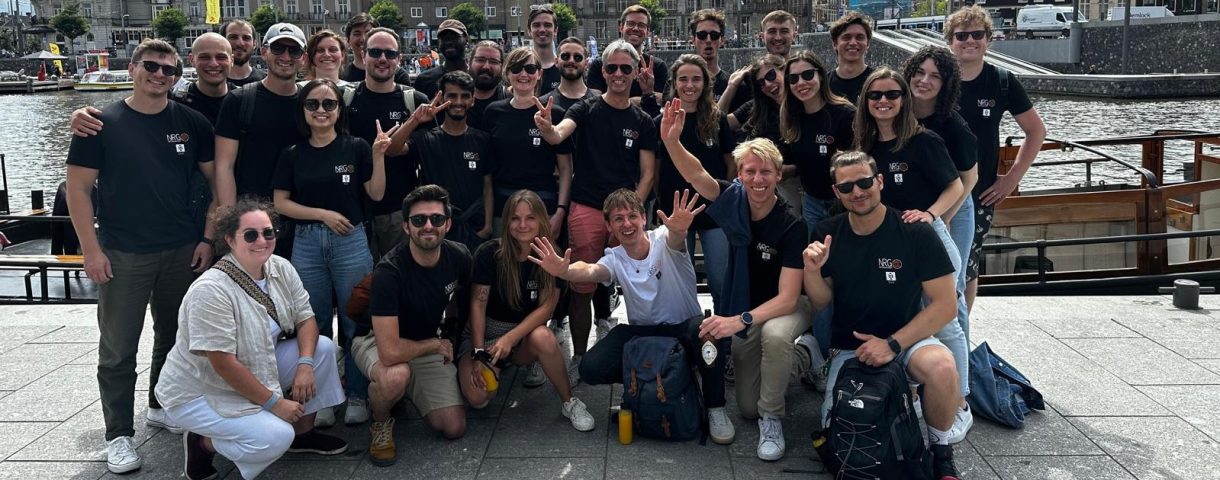
PhD POSITION — HARDWARE & ROBOTICS FOR SELF-DRIVING CHEMISTRY

RoboChem Team · Noël Research Group · University of Amsterdam
Van 't Hoff Institute for Molecular Sciences · Amsterdam, Netherlands
4-year PhD position


ABOUT US

The Noël Research Group sits at the intersection of synthetic organic chemistry and engineering. Our mission: leverage cutting-edge technology to expand the boundaries of chemical space — making synthesis faster, greener, and smarter. We work on flow chemistry, photochemistry, electrochemistry, and autonomous laboratory platforms, publishing in the highest-impact journals in the field.

RoboChem is our flagship self-driving laboratory platform, published in Science. It combines flow chemistry hardware, embedded firmware, and Bayesian optimization to autonomously discover and optimize chemical reactions — running 24/7 without human intervention. We are now expanding the platform with RoboChem-Flex, a modular, open-source successor designed to democratize autonomous chemical experimentation.


THE ROLE

This PhD position is primarily an engineering role inside a chemistry environment. You'll be the person who makes the hardware work — designing and assembling robotic platforms, writing the firmware that talks to pumps, valves, and sensors, and integrating everything into a coherent, reliable system.

You do not need to be a synthetic chemist. You need to understand enough chemistry to know what the hardware has to do — and then go build it.

Day-to-day, your work will span mechanical assembly and 3D-printed component design, microcontroller firmware (Arduino/embedded C), PCB design, software integration with Python-based control systems, and troubleshooting the unexpected things that happen when chemistry meets robotics.


WHAT YOU'LL WORK ON

  • Design and build modular robotic hardware for autonomous flow chemistry platforms
  • Develop and maintain firmware for embedded systems (microcontrollers, actuators, sensors)
  • Integrate hardware with Python-based control and optimization software
  • Design and iterate on custom PCBs, sensor modules, and electromechanical assemblies
  • Develop CAD models and 3D-printed parts for custom reactors and liquid handlers
  • Troubleshoot hardware–software interfaces
  • Document designs and contribute to open-source releases
  • Collaborate with chemists to translate reaction requirements into hardware specs

WHO WE'RE LOOKING FOR

We're looking for someone who is genuinely excited about building things, and who can bridge the world of engineering and chemistry. The ideal candidate has a taste for hardware — but a background in chemistry or chemical engineering is equally welcome, as long as you bring curiosity and a drive to work hands-on with systems and automation.

Background (one of the following):

  • MSc in Chemical Engineering, Mechatronics, Electrical Engineering, Mechanical Engineering, or a related field
  • Candidates with a pure chemistry MSc and strong interest in hardware/automation are explicitly encouraged to apply

What we value:

  • Some hands-on experience with hardware, electronics, or physical systems (this could be from coursework, a thesis project, or personal projects)
  • Comfort with programming — Python, C/C++, Arduino, or similar
  • Exposure to a chemistry or chemical engineering lab environment
  • Curiosity-driven problem-solving: you enjoy debugging and figuring things out
  • Collaborative mindset and ability to work across disciplines

Nice to have (not required):

  • Background in lab automation or process control
  • Experience with CAD (Fusion 360, SolidWorks, or similar) and 3D printing
  • PCB design experience (KiCad, Eagle, or similar)
  • Familiarity with flow chemistry or continuous processing
  • Knowledge of Bayesian optimization or machine learning

WHY JOIN THE ROBOCHEM TEAM

  • Work on a platforms published in Science and Nature Synthesis — and shape their next generation
  • Build real, deployable systems used daily by researchers
  • Interdisciplinary team spanning chemistry, engineering, and machine learning
  • Access to state-of-the-art instrumentation and facilities
  • Publish open-source hardware and software with real-world impact
  • Competitive Dutch PhD salary (full employment, 4 years, in accordance with the CAO-NU)
  • Vibrant, international team based in Amsterdam
  • Direct mentorship from Prof. Tim Noël and senior team members

HOW TO APPLY

If you've read this far and you're the right person, you'll figure this out:

766163616e636965
73406e6f656c7265
736561726368
67726f75702e636f6d
    

Send your CV, a brief motivation letter, and any relevant project work (GitHub, portfolio, thesis excerpts) if you find us!

We review applications on a rolling basis.

Why I wanted to become an academic (and why I stayed)

This post marks the start of a series reflecting on 15 years of the Noel Research Group. Looking back, I realized that the path into and through academia is rarely as straightforward as it may seem from the outside.

I hope that by sharing my experiences, both the good and the more challenging moments, these reflections can be of some use to younger academics finding their own way.

Tim Noel, 21 April 2026

Origins of the ambition

I was born into a working-class family in 1982. My father worked in construction, my mother made curtains. There were no academics anywhere in our family. However, my dad always recognized the importance of school: “Make sure you do well at math, it is important! You do not want to wear dirty pants for a job,” referring to his concrete- and mud-stained trousers that he wore daily on construction sites.

Like any kid, I really looked up to my dad. He is a very hard worker, and as a consequence we never had to worry about money.

School was important, and my parents pushed me to do well. Not to be exceptional, but simply to make sure I could get a decent job later, a job without “dirty pants.” While I generally did well at school, around the 3rd–4th year of high school my grades started to falter. I still attribute that to hormones. Puberty craziness, I guess.

Toward the end of my 4th year in high school, when I was about 16, I became eligible to work during the summer. My father said, “Come and work with us. You’ll earn a good salary in construction, but be aware, it’s going to be tough.”
Sure, why not, I thought. How bad could it be? I had already played soccer for ten years and had fairly good endurance. But oh boy, it was much harder than I expected.

Bringing bricks, shoveling sand and cement to make mortar, wheelbarrowing it to the masons – backbreaking labor, day in, day out. For a while, construction work is almost fun. You’re outside, in the sun, and it feels like you’re a tough guy. But wait until it rains and you have to slush through the mud with a wheelbarrow (Figure 1). Or until the mornings get colder and your hands are so numb you can barely move them, while still having to deliver bricks fast enough to keep up with the pace of these weathered masons.

I was completely exhausted after every day, falling asleep in the car on the drive home. Complaining, taking an extra break, doing a bit less than the others… forget about it. There was no mercy. My dad’s colleagues would say, “We had to do this at your age, so why wouldn’t you?” They had a point. So I never gave up, never asked for mercy, and toughened up.

But something did click in my mind: this is not the job I want to do for my entire career.

The message, whether or not my dad had planned it that way, was delivered. I needed to work harder at school, and I did. My grades went up dramatically, and I became first of the class in the years that followed. All of a sudden, teachers started recognizing me. Only a year earlier, my computer science teacher had asked me at the end of the year, “What is your name again?” I was shocked that after a full year he still didn’t know me. Am I really that invisible? I wondered.

Once my grades improved, teachers did start to pay attention. I became someone worthy of their attention. Classmates began asking me questions and for clarification on the material. All of this nudged me to work even harder. A pattern became clear: school could be a game changer for me. I could become somebody by getting good grades, and I could evade the fate of “dirty pants.”

I went back every summer to work with my dad. And the message remained crystal clear: working hard at school is peanuts compared to working outside on construction sites.

Working on a construction site with my dad
Figure 1. Working on a construction site with my dad, early lessons in hard work out in the open.

University: an unexpected fit

At the end of high school, it was around 2000, teachers were pushing me to dream big. Still, I have to admit that I was scared of university. Nobody in my family had ever gone before me, and I had no real idea what to expect. That I would one day end up in academia was completely unimaginable to me at that point. A PhD? I hadn’t even heard the term when I was 18.

What I did have was a clear interest in science. I generally obtained good grades in scientific subjects, much more easily than in language classes. I considered studying physics, chemistry, engineering, or even psychology. In the end, I chose engineering because it kept the bachelor years very broad, with a wide range of courses. In a way, it allowed me to postpone making a final decision about specialization.

University life turned out to be a perfect match. I also loved the way we were assessed: two major exam periods, one in January and one in May/June. I studied consistently during the year, but there were no daily tests like in high school. So, in other words, far less stress. By the time the exams arrived, I felt prepared and passed them without much difficulty.

At some point, however, I had to refine my choice and select a major. The problem was that I liked almost everything: physics, chemistry, electricity, mechanical engineering. Even in high school, I had enjoyed all the science classes. One of my chemistry teachers once told me that I seemed quite good at organic chemistry. “It’s not an easy subject,” he said, “and maybe you should do something with that talent.” That small piece of encouragement stayed with me.

In the end, I chose Industrial Chemical Engineering.

It was during the first year of my master’s degree that I became familiar with the term PhD. People who are paid to do research. That sounded incredibly exciting. I started talking to my professors, and they encouraged me to consider it. But then came the next question: on what topic?

Once again, I gravitated toward organic chemistry, following the advice of my old high school teacher. I liked the idea of building molecules and tailoring them for specific applications. Still, it was not a straightforward choice for a chemical engineer, especially one who had essentially missed all the key organic chemistry courses.

Finding a PhD Position the Hard Way

While obtaining my MSc in Industrial Chemical Engineering went relatively smoothly, starting a PhD in synthetic organic chemistry did not.

Because I did not have the right background, the University of Ghent required me to complete a predoctoral year. This involved six courses, roughly equivalent to half a year’s worth of credits. One or two subjects were interesting, but overall I found the year rather useless, with little practical value. On top of that, there was simply too much unstructured time, and I started doubting myself a lot.

Importantly, this predoctoral year did not guarantee a PhD position. In other words, it was entirely possible that the whole year would turn out to be a waste of time.

Prof. Johan Van der Eycken, whose lab I had selected as a potential host for my PhD, kindly supported me and allowed me to do research in his group. And yes, I still loved the experiments. But the insecurity about whether I would actually get a PhD position started to weigh on me more and more.

In Belgium, most PhD positions require applying for competitive grant schemes, such as the FWO. And peers, as peers can be, are sometimes not particularly kind. Comments like: “Well, you had excellent grades in engineering, but now you’re doing synthetic organic chemistry. I guess they’ll prioritize chemistry MSc students.”
Was I, indeed, fucked?

Looking back, this was probably one of the hardest periods of my career. I had the strong feeling that I had completely messed things up. Was choosing engineering the wrong decision after all?

When I submitted my proposal to the FWO, the result confirmed my fears: I did not get the funding. Johan then said, “There is a backup plan. Let’s try BOF funding,” an internal, institutional funding scheme. We applied, and luckily for me, it worked.

The funding was approved, and I could finally start my PhD in Prof. Van der Eycken’s team. A lot of the dark thoughts dissipated. The insecurity slowly made space for exuberance.

The PhD – not a smooth race either

In September 2005, I finally started my PhD. Like many PhD students, I was naively excited and ready to make ‘big’ discoveries. The project focused on synthesizing new chiral ligands for transition-metal catalysis. Prof. Van der Eycken gave us complete freedom to shape the research as we saw fit.

Behind my back, however, I did sense some skepticism from fellow PhD students. “What is an engineer doing in a chemistry environment? Engineers don’t know anything about synthetic work.” Even when I only heard this second-hand, it bothered me. It made me want to work harder and prove myself. I should add that this is not unique to academia, there are naysayers everywhere in life. The challenge is learning not to let them define you.

I started working on chiral dienes, a new ligand class pioneered by the Hayashi group (University of Kyoto) and the Carreira group (ETH Zurich). To stay focused, I set myself small, concrete goals: develop a viable synthesis for my first ligands within three months and test them in benchmark reactions.

Everything went according to plan, until it didn’t.

A paper from the Hayashi group appeared, describing exactly the same synthesis. I had just been scooped on my very first project. Panic set in. I went to Prof. Van der Eycken, who advised me to wrap up the work as quickly as possible so we could submit as well. I wrote the manuscript, and the paper was eventually published.

It was my first academic paper. My name was there, in print. That may sound a bit over the top, and perhaps it was, but it gave me one of the best feelings I have ever had. Publishing made me feel like I was no longer just a number. I had contributed something tangible, something that other scientists would read and build on. It felt great.

Still, being scooped was not a great experience. It’s not great for morale, it causes stress and it’s not great for the impact factor of the journal you had in mind. Many people in academia will experience being scooped at least once in their career. In a later post, I’ll return to this topic and discuss how my current group tries to reduce the constant fear of being second in scientific projects. (Spoiler: there are things you can do.)

I learned an important lesson and moved on quickly. One strategy to reduce the risk of being scooped again was to work on a completely new class of ligands: chiral imidates. That direction worked well, and I was able to publish several papers during my PhD.

Publishing, however, was not the norm in our group at the time. Most colleagues published little or not at all during their PhD. This sometimes led to awkward situations and unintended tension. I am aware that I can come across as highly ambitious, and that probably shows. In an environment with different expectations, this occasionally made me feel quite lonely, even though I genuinely loved the work.

During my PhD defense, I had a fantastic time, sparring ideas and scientific concepts for two hours with high-level professors (Figure 2). My family, friends, and colleagues were there, and it was one of the proudest moments of my life. They could see that I was in my element.

So despite the doubts, the competition, and the occasional loneliness, the PhD years were formative in the best possible way. I learned a great deal about myself and about what truly drove me, and they confirmed that I wanted to stay in academia.

PhD defense at Ghent University
Figure 2. Hora est: PhD defense at Ghent University (November 2009).

The Postdoc – the preamble

With my PhD drawing to a close and my decision to stay in academia becoming clear, I started scanning postdoc options and doing interviews about a year before finishing. I thought I had secured a position; a handshake deal that, at the time, felt reassuring.

As it turned out, I hadn’t.

This is a cautionary tale for every young academic: as long as you do not have a contract, you have nothing. Indeed, about one month before the end of my PhD, I contacted the group I had been in touch with, only to find out -much to my dismay- that there was no money to finance my stay after all.

I panicked. I even offered to work for free. That, of course, is not really possible in a chemistry lab, given the safety regulations. So I had to look elsewhere. But this was 2009, and the financial crisis was hitting Europe hard. There were not many options.

I sent out many applications across Europe. My goal was to stay close to home so I could go back on weekends to see my wife, we had only been married for a year… Despite dozens of emails, many went unanswered. Those who did reply often suggested that I apply for personal fellowships instead. Meanwhile, the clock was ticking, and I was about to be out of a job. Why did academia always feel so stressful?

At some point, I started sending applications to the United States. If I was serious about an academic career, I realized I would have to make sacrifices, even if that meant going overseas and being separated from my family for long stretches of time. So I told myself: “if I’m going that far, I should aim for the very best.” And if it didn’t work out, at least I would know I had tried.

I sent out four applications. Soon after, I received a response: from Prof. Stephen L. Buchwald at MIT. My first reaction was simply: wow. Working with him would be a dream. I made sure to collect as many letters of support as I could: five, from people with very different perspectives who knew me well. And then, sometime in January 2010, I got the offer.

I was going to MIT. My god.

My wife was supportive from the very beginning, but it was not always easy to explain this decision to other relatives and friends. Going that far away for “just a job” did not seem self-evident to everyone. Belgians, after all, tend to be quite around-the-tower people. When I tried to explain it to my parents, I used a football analogy. I told my dad: “if I were playing for a local team and had the chance to play in the Champions League, would you take it?”

“Of course,” he said.

“Well,” I replied, “MIT is like Barcelona or Real Madrid. And I’m not going to sit on the bench, I’m going there with the intention to play.”

He immediately understood. And I had their blessing.

The Postdoc – Finding My Place

On March 30, I landed in the USA. The day after, I went to the lab for the first time. When I exited the T at Kendall Square, I felt butterflies in my stomach. Even though I am not particularly religious, I remember touching the ground at MIT and saying to myself: “God, please help me to be successful here.”

Steve was great, and the team was extremely welcoming. I felt supported from day one. I hate to admit it, but I had expected something else. High-performing places often have a reputation for being tough, competitive, and highly protective of individual projects. What I encountered was the opposite. People were open, friendly, and incredibly generous with their time and ideas.

One example has always stayed with me. I asked a colleague about a scientific problem I was facing. On the surface, it seemed like a simple question, and I felt a bit ashamed even asking it. He answered honestly: “I have no idea either. It seems like something we should know, but I’m not sure either.”

That moment was surprisingly powerful. People who dared to admit that they didn’t know created an atmosphere in which I could be myself. If I made a mistake, so be it. I never felt judged. It felt like home.

In such an environment, I felt I could get the best out of myself. And I worked hard, not out of fear, but out of motivation. I knew that every paper with MIT as an affiliation on my CV would be noticed and would improve my chances at the next stage: finding a tenure-track position.

The topic assigned to me was flow chemistry: translating some of the well-known Buchwald chemistry into continuous-flow reactors. The project was part of the MIT–Novartis Center for Continuous Manufacturing and exposed me to a wide range of people: engineers, chemists, and scientists from industry.

Very quickly, something clicked. To make real progress, I needed both my engineering background from my MSc and my training in synthetic organic chemistry from my PhD. What had initially felt like a liability during my PhD now became an asset that set me apart. I could approach problems from both perspectives, which allowed me to resolve lingering issues more efficiently and find the right synergies. I felt completely at ease with the project and was able to make an impact quickly, with a first paper drafted within the first six months.

With every project I tackled, my confidence grew. Again, my mixed background gave me an edge that I did not see as clearly before. What once seemed like a weakness had turned into a unique strength, almost a superpower. It didn’t take long before I realized that, if I were lucky enough to obtain a position, this would likely become the core theme of my independent research career.

Another important aspect of MIT was the peer group (Figure 3). Many colleagues shared the ambition of pursuing an academic career, which led to countless informal discussions about ideas, strategies, and future plans. There were even dedicated courses on how to start an academic career: how to prepare grant proposals (something I hadn’t even realized was necessary at that stage), how to interview for faculty positions, and how to structure job talks and seminars.

Looking back, this exposure was invaluable. I am very aware that being able to experience all of this was a privilege. Had that first postdoc option (the handshake deal) actually gone through, I might never have ended up at MIT. And would I then have stumbled upon flow chemistry? Who knows. What I do know is that I grabbed the MIT opportunity with both hands and enjoyed every second of my postdoc. Many of the choices I later made as an independent PI trace back directly to that period…

Group picture during Steve Buchwald's birthday party at Redbones
Figure 3. Group picture during Steve Buchwald’s birthday party at Redbones, 2010. Can you find me? 😉

The next episode – looking for a way into the tenure track

After about a year into my postdoc, I started seriously considering the next step in my academic career: how to secure a faculty position. In Belgium, the classical route is to return as a local postdoc, so I applied for FWO funding.

A few months later, the verdict came in. I had narrowly missed the cut. I had nothing.

It was a huge blow. I didn’t understand why I hadn’t gotten it, and my confidence dropped to rock bottom.

One day, Steve passed by my desk and asked what had happened. I told him the story. He looked at me and said, “Why are you applying for another postdoc? I actually think you’re ready to apply for academic positions.”

That took me completely by surprise. I asked him if he was serious. He was.

“Tim,” he said, “you’re doing really well here. You don’t need to go. Stay as long as you need to find the academic position you want. I think you’re fantastic in flow chemistry.”

I had tears in my eyes. That moment, that boost of confidence, has stayed with me ever since.

So I pivoted. I started applying directly for tenure-track positions. I was invited for two interviews, one at TU Eindhoven and one at Utrecht University, both in September 2011.

I spent the months leading up to the interviews preparing meticulously. I wrote a coherent research proposal focused on photocatalysis in flow. Photocatalysis was emerging as a hot topic in synthetic organic chemistry, and I believed strongly that it needed better technology. Flow chemistry, I felt, could make a real impact. And because relatively few applicants had a background in flow chemistry, I thought I might have a competitive edge.

The interviews went remarkably well. I didn’t have to look further. I received two offers. At that stage of my career, luck was clearly on my side. My independent academic career could begin … but that story I’ll save for another post. Stay tuned.

Stepping back (with hindsight)

It’s worth pausing here.

Only with hindsight did I fully realize how contingent this path was. I had originally wanted to do a postdoc in enantioselective catalysis, but that plan failed. The reviewers of that grant wrote: “You already have experience in this field. Why do it again?” At the time, I found that reasoning confusing and frustrating.

Now, I see their point.

Repeating what you already know during a postdoc is rarely the best strategy. Expanding your horizons, geographically, intellectually and technically, matters. Because that first plan failed, I had to apply again. That detour brought me to Massachusetts Institute of Technology, a place I initially thought was completely out of my league. There, I encountered flow chemistry, a topic where my combined background in engineering and chemistry suddenly became a strength rather than a liability.

When photocatalysis began to take off in synthetic organic chemistry, the pieces fell into place. The dots connected. That became the topic I started my independent career with. And, fifteen years later, it is still a core theme in my group.

Tim Noël
Amsterdam, April 2026

The story behind the Science paper – How our team created RoboChem

When I embarked on my independent academic career, my mission was clear: to push the boundaries of synthetic organic chemistry through technological innovation. One of my most audacious dreams was to create a chemical robot capable of working alongside human chemists, alleviating the burden of arduous and time-consuming tasks, such as reaction optimization. However, from the outset, I knew that this endeavor would be anything but easy. The examples I found in the literature appeared prohibitively expensive, requiring a diverse team with a wide range of skills, and the assembly process would be a time-consuming challenge in itself. Could we realistically pull this off? At the dawn of our research group, the answer was a resounding ‘no.’ Our team was small (1-5 PhD students in the first five years), resources were limited, and the risks loomed large: the potential for burning through funds and human capital without any publication to show for it. At that time, this was a risk we simply couldn’t afford to take.

The assembly of the team

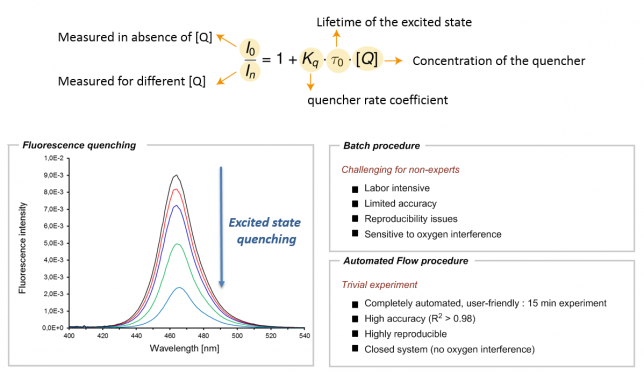
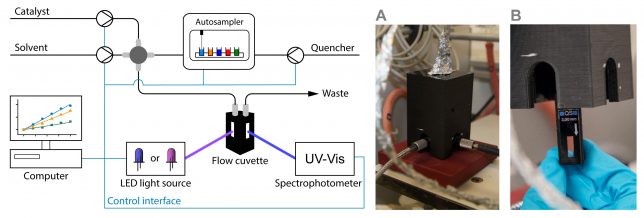
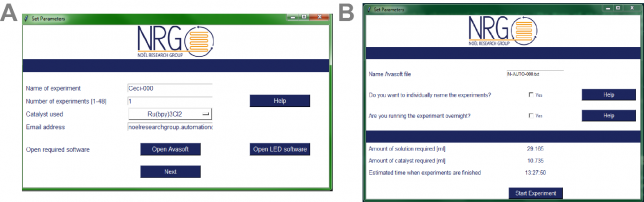
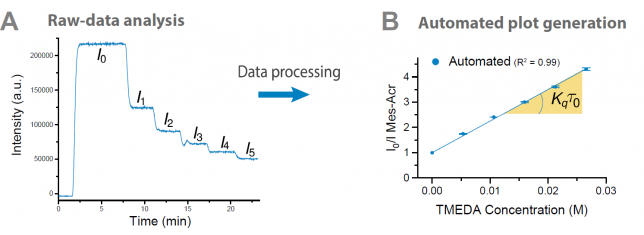
Confidence in embarking on robotic projects began to take shape gradually after we successfully published an automated strategy for conducting Stern-Volmer experiments.[1] This platform, while relatively simple and cost-effective, made a significant scientific impact by delivering highly reproducible results for these notoriously finicky kinetic experiments.

Enter Zhenghui Wen: When I welcomed in September 2018 Zhenghui Wen, a skilled chemical engineer from China, to our team, I explained our ambitious vision. Zhenghui’s immediate enthusiasm ignited a flurry of activity. He began 3D-printing a multitude of reactors and liquid handlers while also diving into programming Arduino drivers. However, it soon became evident that the RoboChem project couldn’t be a one-person endeavor — though Zhenghui did exceptional work. We made the challenging decision to temporarily halt the project.

Around 2020, the tides began to turn in our favor. Our success in securing funding improved substantially, and our research group underwent remarkable growth. Additionally, I received a valuable startup package at the University of Amsterdam, enabling the purchase of a benchtop NMR, a pivotal yet costly instrument that would provide critical data on yield and selectivity.

Aidan Slattery Joins the Team: Around September 2020, Aidan Slattery, an Irish chemist with invaluable flow experience gained at SnapDragon, became a vital addition to our team. His dedication was fully committed to realizing the RoboChem vision.

Pauline Tenblad’s Expertise: Just a few months later, we were fortunate to welcome our first Swedish PhD student Pauline Tenblad. Her expertise in chemical engineering was crucial for the machine learning efforts required to enable self-optimization within the RoboChem platform.

Dr. Diego Pintossi Takes the Helm: Joining the team alongside Pauline was Dr. Diego Pintossi, a versatile, Italian chemical engineer. His role involved mentoring, coordinating efforts, and ensuring a seamless and productive journey toward our objectives.
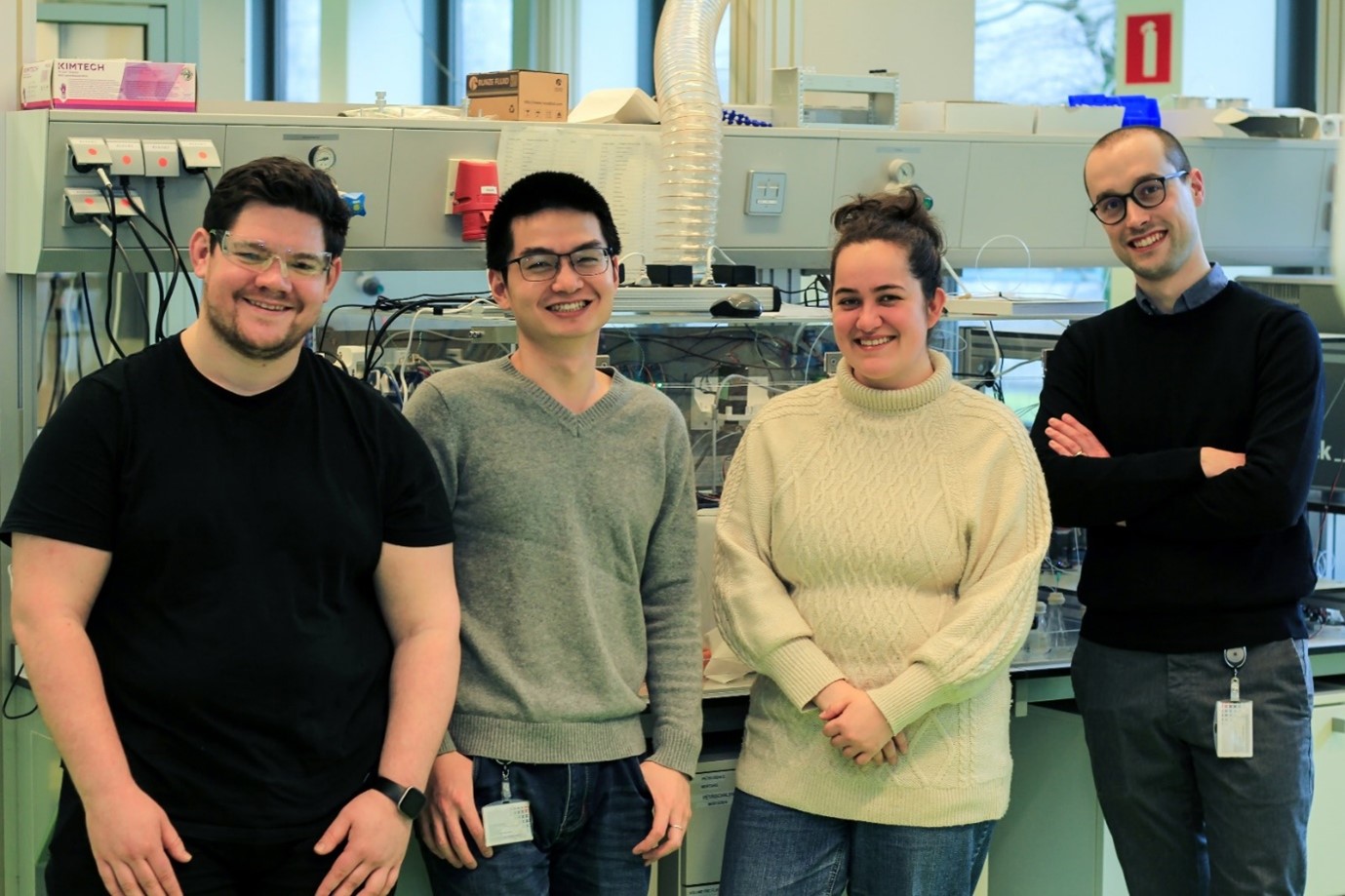
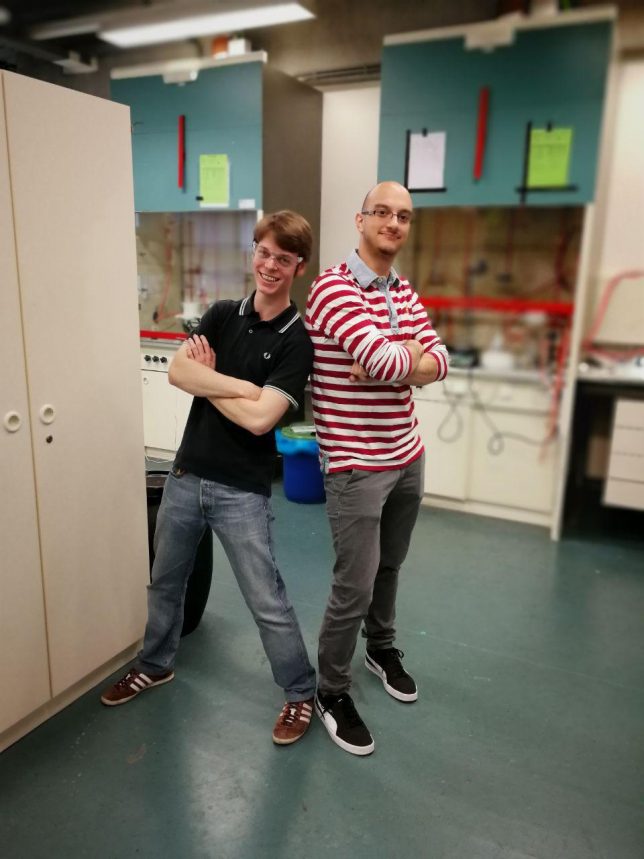
Picture 1. Meet the Pioneers: The Original RoboChem Team in Front of the Platform (left to right): Aidan Slattery, Zhenghui Wen, Pauline Tenblad, and Diego Pintossi.

Assembling Hardware and Seamlessly Integrating it with Code: Bringing the RoboChem Vision to Life

These four exceptional researchers embarked on the formidable task of assembling the intricate hardware components and executing the essential coding for our project. The challenges we encountered during this phase were nothing short of daunting.

One major challenge we grappled with was the need for precise control over every piece of equipment through software integration (Figure 1). This necessitated the development of a sophisticated control system to ensure precise functionality of each component. Hardware-related hurdles further compounded our efforts, with compatibility issues and the need for meticulous fine-tuning of mechanical components becoming recurring challenges. For instance, we faced ‘lost in translation’ moments between our 64-bit software control and 32-bit hardware. Switching between these applications took Pauline a few days to untangle. There were countless other small, not-so-glorious issues to resolve, many of which won’t even make it into the final paper.

As progress proved slow and tangible results were limited, the paramount task at hand became maintaining focus and motivation. Tim den Hartog, a visiting researcher from Zuyd University of Applied Sciences, and I took it upon ourselves to keep the team’s spirits high throughout this challenging phase. Together, we actively participated in the biweekly ‘RoboChem meetings,’ where we discussed our ongoing progress and offered suggestions to overcome some of the hurdles that we encountered.

The combined effort of coding and hardware installation stretched over an arduous 2-3 year period, emphasizing the monumental nature of our undertaking. You might wonder why we didn’t opt for readily available off-the-shelf units. The answer, though deceptively simple, lies in the flexibility required for our highly specific applications. Most commercial units function as black boxes, lacking the adaptability needed for our unique project demands. Tailoring such units to our requirements would have presented nearly insurmountable challenges.
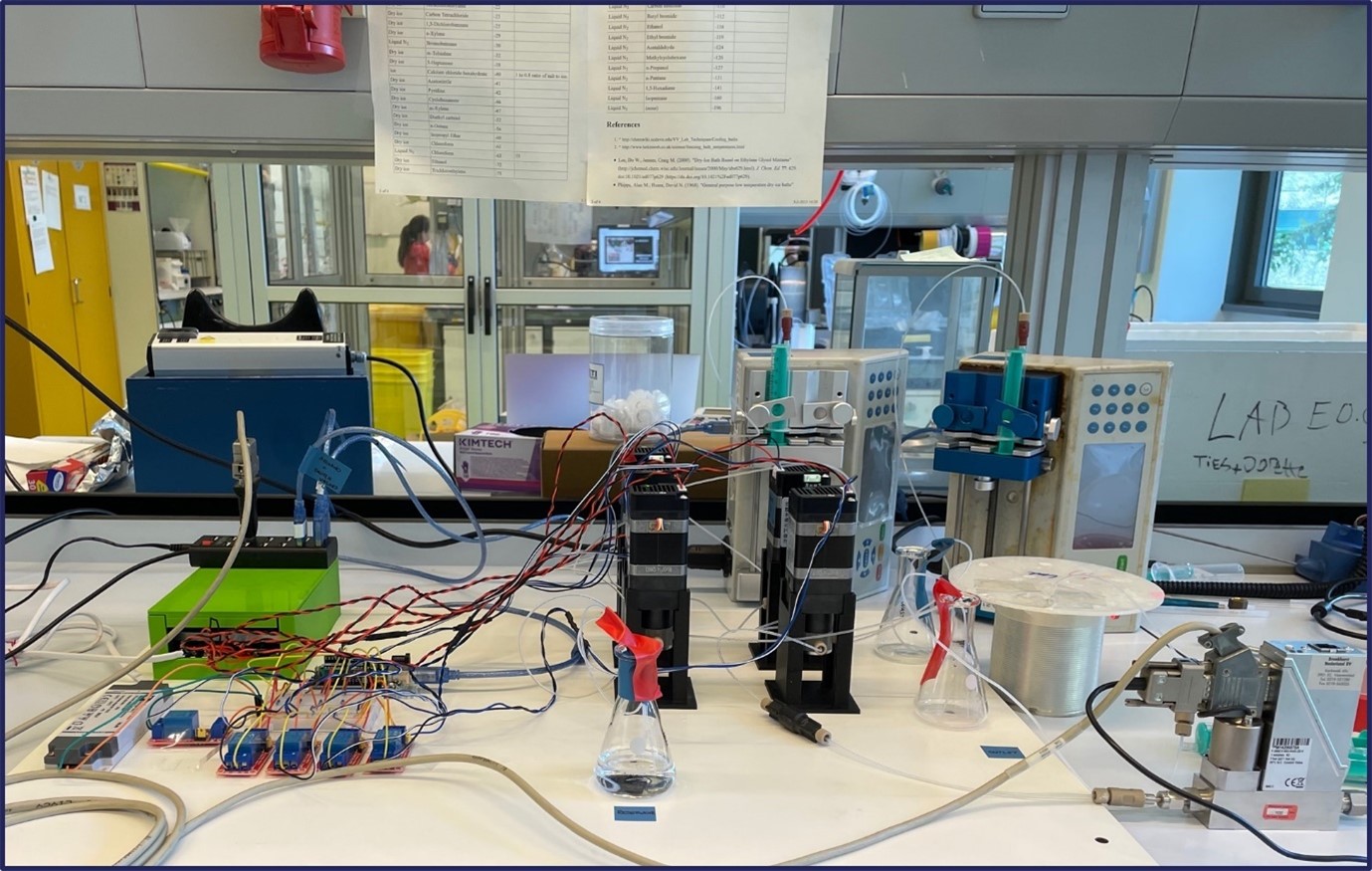
Figure 1. Embarking on the First Automated Steps: Taking the initial strides in automating syringe pumps and mass flow controllers, and implementing Arduino controllers.

The First Test: From Stress to Relief, A Remarkably Smooth Journey

But once all the bugs were meticulously ironed out of our system, we stood on the precipice of a crucial milestone—the first test (Figure 2). Our focus honed in on photocatalysis, a domain in which our group has ample experience. We decided to implement one of our versatile photochemical flow reactors within RoboChem, complete with a set of high-intensity LEDs.[2] This allows us to tune the light intensity meticulously, a feature we think might be important for the optimization of photocatalytic transformations.
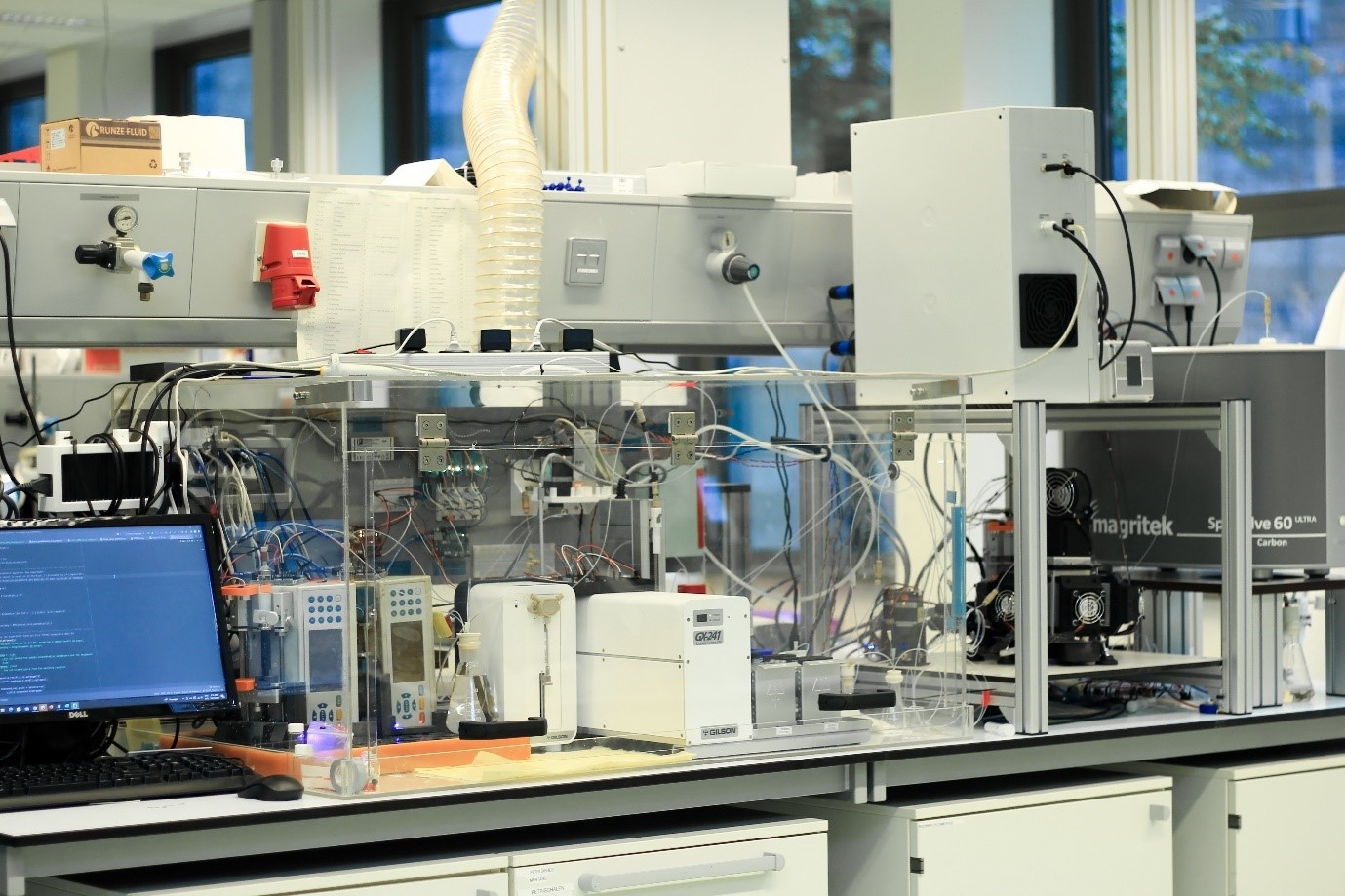
Figure 2. The RoboChem Platform: Fully Assembled and Primed for Inaugural Testing.

I must admit that during this critical phase, I took a step back from the lab, preferring not to add any additional stress to my dedicated team. However, behind that cautious facade, I was filled with eager anticipation. You see, the stakes were exceptionally high. If this inaugural test failed to yield results, it would have meant a significant investment of time wasted, not to mention the daunting task of restoring the team’s confidence. [The specter of potential failure loomed heavily over us.]

On July 21, 2022, as I went about my day, a notification chimed on my phone—a WhatsApp message from Aidan. It was a moment that would define our journey (See Figure 3). The message held the key to our hopes and fears. The results were nothing short of astonishing: the experiment worked seamlessly, and we achieved an unprecedented level of optimization. We had successfully executed a photocatalytic hydrogen atom transfer-induced Giese-type radical addition to benzalmalonitrile. The euphoria that swept through our team was palpable, and in that instant, we knew we were on the cusp of something remarkable.
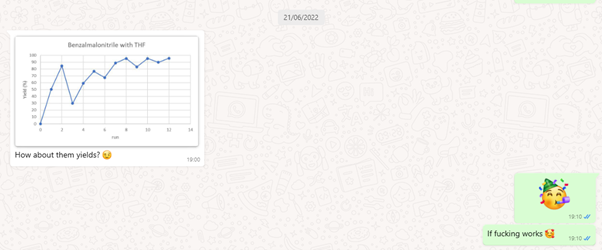
Figure 3. WhatsApp message from Aidan, filled with excitement, prompts an exuberant response from Tim, signaling a groundbreaking moment in the RoboChem project [pardon the F-bomb from Tim].

Progressing Forward: Exploring Diverse Case Studies

Once we obtained those initial results, and I assure you, this was truly a first result (no joke), we realized that we held something incredibly valuable in our hands. We also understood the importance of showcasing the full potential of the RoboChem platform. If we could achieve that, we knew we might be holding the key to a top-tier paper. I instructed the RoboChem team to explore the system thoroughly, with the understanding that once we comprehended its capabilities, we would be able to devise a strategic plan for our next steps.

Around November 2022, I reached out to Zhenghui and Aidan, suggesting that we select a diverse array of photocatalytic synthetic methods and initiate a small-scope optimization, typically with around five examples per method. It was at this stage that our Spanish postdoc Jesus Orduna, who was already a year in our NRG team, joined the RoboChem team, bringing his expertise to assist in chemistry selection, results analysis, and compound isolation.

Our working hypothesis was that while chemists often develop a single set of conditions and apply them universally across the substrate scope, individual AI refinements tailored to each molecule could yield superior results. Additionally, we were well aware of the challenges associated with photocatalysis. This activation mode is notoriously complex, involving intricate photophysics and poorly understood mechanisms. Moreover, technological issues, such as setup variability and irradiation profiles, contribute to interlaboratory irreproducibility, making it a time-consuming endeavor to achieve consistent and reliable results. In other words, the ideal testcase to validate RoboChem!

To our delight, we found that across all examples, spanning hydrogen atom transfer photocatalysis and photoredox catalysis, the RoboChem platform either matched or significantly surpassed yields reported in the literature. It often surprised us by making nuanced choices, such as opting for very low light intensity when beneficial for a specific molecule, while favoring higher intensities in other cases. The data yields more intriguing conclusions, all of which are elaborated in the paper. Notably, for each substrate, we compiled comprehensive data sets with results spanning from low to high yields, providing a clear picture of the parametric sensitivity for each molecule. This approach, we believe, sets our research apart as in literature typically only the best results are highlighted.

The importance of reproducibility

While the results exceeded our wildest dreams, it was imperative to eliminate any room for error. To achieve this, we implemented a rigorous quality assurance process. We utilized the best reaction conditions and ran them consistently in the same photochemical flow reactor, yielding up to 5 mmol of product in each case. Aidan, Zhenghui, and Jesus took on the demanding task of isolating all the compounds, with the obtained yields closely mirroring those achieved with the inline benchtop NMR (Picture 2). Subsequently, each compound underwent comprehensive characterization through NMR, MS, and other analytical techniques. Although time-consuming (we believe that this human isolation and characterization phase served as the rate-determining step, as the entire optimization protocol was fully automated and hands-off), it provided us with unwavering confidence that the results delivered by RoboChem were genuine and not a mere fluke.
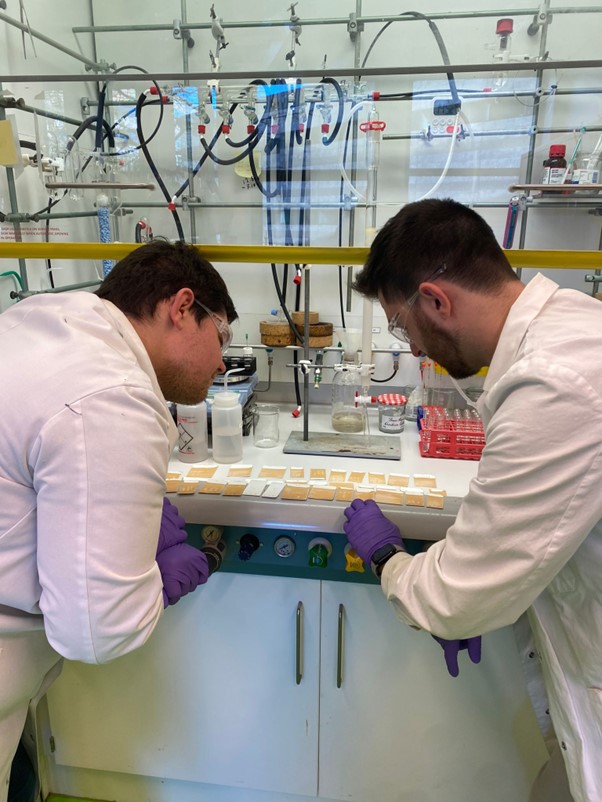
Picture 2. Capturing Dedication: Jesus and Aidan, sleeves rolled up, diligently isolating the final compounds.

Paper Submission: The Waiting Game Begins…

Once we had gathered all the data, the exciting journey of crafting our paper began. The initial draft took shape in the hands of Aidan and Pauline, while Zhenghui worked his magic to create the graphics that would highlight our findings. When they presented me with their rough draft, I couldn’t help but feel a surge of enthusiasm. This phase, where you take the collective hard work and start shaping the narrative, is one of the most enjoyable aspects for me.

Typically, I maintain very close contact with the team during this process, bombarding them with multiple questions every day, whether in person or via WhatsApp. We delve into intricate details and fine-tune the storyline. This collaborative refinement process, however, demands time and dedication. For a paper as multifaceted as this one, integrating various disciplines such as chemistry, chemical engineering, programming, machine learning and robotics, it takes me at least two weeks to craft a narrative that we can all take immense pride in.

During the revision process, the team dedicated themselves to creating a comprehensive Supporting Information section, meticulously detailing procedures, characterizations, and optimization tables.

Once everyone was satisfied with the manuscript, we submitted it to ChemRXiv[3] and I began presenting it at conferences. The first opportunity arose at the 6th Flow Chemistry and Continuous Processing Conference in Boston (May 2-3, 2023). The prospect of sharing our work in the city where my journey began, learning flow chemistry at the Buchwald Research Group at MIT, just a 5-minute walk away, filled me with excitement. After my presentation, I was inundated with questions, particularly about RoboChem. The enthusiasm from the audience remained consistent throughout subsequent talks. I even made a playful remark to the RoboChem team that, while I was joking, held some truth: if I wanted questions on other parts of my talk, I’d have to remove RoboChem from the slides.

This overwhelmingly positive feedback boosted our confidence to aim high and submit the paper to the most prestigious journals in our field. We set our sights on Science (See Figure 4A). The submission was met with anticipation and nervous excitement. A promising sign emerged when the paper was sent out for review, spotted in the portal by Aidan (See Figure 4B). Then, on July 31, an email from the Science editor arrived, containing the feedback from the referees. The feedback was predominantly positive, and I couldn’t contain my excitement when I shared the news with the RoboChem team (See Figure 4C). Two referees had provided feedback with an acceptance recommendation, while one referee had a few specific requests, the most notable being, ‘Can you explore dual catalytic pathways, as these are notoriously challenging to optimize?’
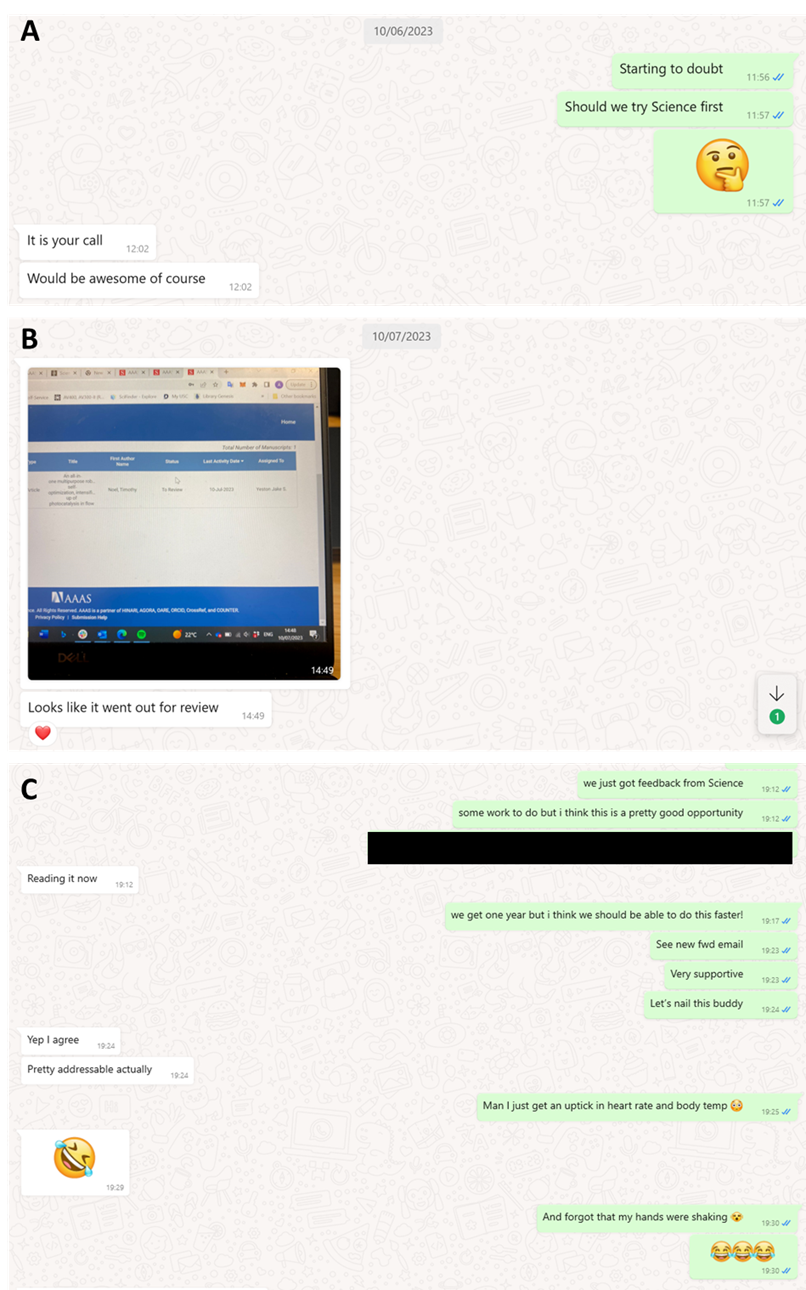
Figure 4. Snapshot of key WhatsApp conversations between Tim (in green) and Aidan (white): (A) Should we try to submit to Science? [June 10, 2023] (B) Paper sent out for review, excitement gets built up. [July 7, 2023] (C) Feedback is in, two yes and one conditional feedback. We are in business, however, more work to do! [July 31, 2023]

The Final Stretch: Let’s Ace This One…

When you receive such exceptional feedback, two emotions intertwine: excitement and nerves. On one hand, the excitement of receiving fantastic feedback and the prospect of a potential paper in Science ignite your spirits. On the other hand, the nerves creep in; you realize you can’t afford to squander this remarkable opportunity. The twist was that we were all on vacation when this happened, so we couldn’t dive into action right away. Aidan and Jesus had to handle things in the lab, and Zhenghui, who had been an integral part of our team, had returned to China, become a father and was applying for jobs. In fact, he even pondered, ‘Should I come back? I am willing to do this!’ This underscores the unwavering dedication of our team to see this through.

Once our vacation ended, and we had some time during the break to strategize, we swiftly concurred that we needed to perform the experiments requested by referee 3. We opted for a photocatalytic cross-electrophile coupling, a realm we had recently explored and understood well.[4] This familiarity instilled confidence that we could execute it successfully. However, our initial attempt didn’t yield promising results; our NMR showed virtually nothing. It was at this point that Jesus’s background in organometallic chemistry came to our rescue. He suspected the interference of paramagnetic nickel, which was muddling the NMR signals. Indeed, by introducing a slight excess of ligand, we managed to prevent the formation of this nickel species and finally observed the NMR signals essential for quantification.

At this stage, we decided to go all out, exploring an extensive chemical space, incorporating both continuous and discrete variables. To our astonishment, the results were nothing short of spectacular, surpassing our original conditions by substantial yield margins and offering a plethora of unique insights (thank you referee 3! Your suggestion proved one of the most compelling cases we carried out on RoboChem). We once again meticulously isolated the compounds to validate the RoboChem results and submitted a revised version along with a rebuttal addressing all the questions. And then, the waiting game commenced.

While our confidence was high upon submission (we had diligently fulfilled all their requests), with each passing week, our anxiety grew (Had we truly covered everything? Why was it taking so long?). Aidan and Zhenghui kept refreshing the portal incessantly; minor updates appeared, but no email landed in my inbox. Sleep became elusive, as I frequently woke up (considering the 6-hour time difference with the USA, could the email arrive during our night?). Finally, on November 20th, while I was aboard the TGV to Lyon, I opened the long-awaited email from the editor. The news was favorable; referee 3 acknowledged that the new results were indeed compelling, albeit referee 2 had some additional questions. Fortunately, these seemed to revolve around textual changes, sparing us from further experimental work. We invested ample time to address them to the best of our ability and submitted the revised version within two weeks. On December 13th, the ultimate acceptance letter from the editor arrived, and it was an immensely gratifying moment (see Figure 5). While we had anticipated the acceptance by then, receiving the final verdict was still a heartening relief.
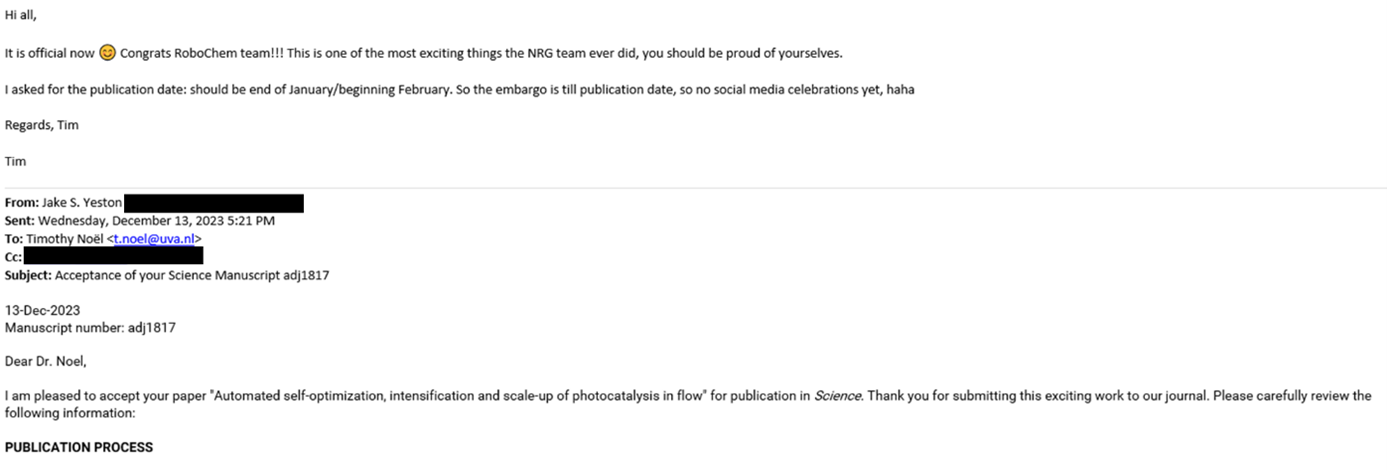
Figure 5. The Elation of the Final Acceptance Letter and the Joyous Forward to the RoboChem Team.

Some last remarks…

As we stand here today, a few weeks after the fact, our paper has been published online by Science.[5] The sense of accomplishment still lingers, and our team is tirelessly working on exploiting and expanding the RoboChem platform for new applications. We sincerely hope that you find our paper and the story behind its creation as enjoyable as we do.

While the conclusion is a happy one, the journey to reach this point was marked by numerous ups and downs. We encountered setbacks, moments of stress, and challenges that tested our resolve. By offering you this behind-the-scenes account, we aim to provide you with a genuine glimpse into the genesis of this work and our approach to projects within our research group. It’s crucial to recognize that this success was the result of dedicated individuals, each possessing unique and complementary skills. We embarked on this journey without full foresight of how it would unfold, and it was during the assembly of various components that the platform revealed its true potential.

Tim Noël
Amsterdam, 25/01/2024

[1] Kuijpers K.P.L.; Bottecchia, C.; Cambié, D.; Drummen, K.; Koenig, N. and Noël, T. A fully automated continuous‐flow platform for fluorescence quenching studies and Stern‐Volmer analysis. Angewandte Chemie International Edition 2018, 57(35), 11278-11282 DOI: 10.1002/anie.201805632.

[2] Wan, T.; Wen. Z.; Laudadio, G.; Capaldo, L.; Lammers, R.; Rincón, J. A.; García-Losada, P.; Mateos, C.; Frederick, M. O.; Boroersma, R. and Noël, T. Accelerated and Scalable C(sp3)–H Amination via Decatungstate Photocatalysis Using a Flow Photoreactor Equipped with High-Intensity LEDs. ACS Central Science 2022, 8 (1), 51-56 DOI: 10.1021/acscentsci.1c01109

[3] Slattery, A; Wen, Z; Tenblad, P.; Pintossi, D.; Sanjose-Orduna, J.; den Hartog, T. and Noël, T. An all-in-one multipurpose robotic platform for the self-optimization, intensification and scale-up of photocatalysis in flow. ChemRxiv, 2023, DOI: 10.26434/chemrxiv-2023-r0drq

[4] Luridiana, A.; Mazzarella, D.; Capaldo, L.; Rincón, J. A.; García-Losada, P.; Mateos, C.; Frederick, M. O.; Nuño, M.; Buma, W. J.and Noël, T. The Merger of Benzophenone HAT Photocatalysis and Silyl Radical-Induced XAT Enables Both Nickel-Catalyzed Cross-Electrophile Coupling and 1,2-Dicarbofunctionalization of Olefins. ACS Catalysis 2022, 12 (18), 11216–11225 DOI: 10.1021/acscatal.2c03805

[5] Slattery, A; Wen, Z; Tenblad, P.; Sanjose-Orduna, J.; Pintossi, D.; den Hartog, T. and Noël, T. Automated self-optimization, intensification and scale-up of photocatalysis in flow. Science 2024, DOI: 10.1126/science.adj1817
My personal story to obtain an ERC grant – 7 submissions, 4 interviews and 6 heartbreaks

Every young academic will sooner or later take a shot at applying for an ERC grant. ERC grants are considered to be amongst the most prestigious grants out there. It provides you sufficient funding to establish a high risk/high gain research line. Obtaining one is considered a game changer in your academic career: it is a prestigious award, it greases the wheels for getting tenure and it can even be used as a bargaining chip to secure a position elsewhere.

In this blog article, I aim to give you a -as honestly as my memory allows it- recollection of all the attempts I undertook to obtain an ERC grant in the past decade. I guess most of you will think it has always worked out for me the first time right; well, I can tell you that has rarely been the case. In life like in science, failures are rarely reported (although I always honestly mention it in my personal discussions with colleagues and young academics). However, failures happen frequently to me, as you will read below; my story is far from unique if you ask around. My hope is that this account provides young academics with some more insight into my ERC journey and gives them hope for their own ERC mission.


The Starting Grant

Like many, I was eager to roll the dice and try early on in my independent academic career to apply for the Starting Grant (ERC-2013-StG). I prepared by collecting as many successful proposals as I could get my hands on and trying to discover an underlying structure for what a winning proposal might look like. I brainstormed with colleagues about potential ideas I had, and after a few sessions, I felt confident that I had a bold idea that fit the high risk/high gain category.

I focused for the next few weeks, fervently writing the proposal and I even managed to rope in some colleagues for proofreading duty. Either they were just too nice or didn’t have the heart to say otherwise, but the feedback was unanimous that it was at least good enough to get an interview. Full of confidence, I submitted both B1 and B2 parts and I waited …

A few months later I got an email … from the ERC. Excited and nervous, I opened it and my face immediately dropped: shit … a B grade, indicating that the proposal was of high quality but not sufficient to be invited for an interview. Back then, you still had to wait longer to get the evaluation reports so I couldn’t even tell why it is was deemed “not good enough” (thankfully, that has changed in the meantime and now the decision and the reports are sent together). After a few weeks of waiting, I got the feedback. “The project targets the development and implementation of photo-redox catalysis to be used in microreactors, which is argued to improve the efficiency of the photochemical processes. The ideas are interesting and reasonably well based on state-of-the-art. Unfortunately, the panel finds that the project is described in a rather generic fashion.

OK, I thought, this feedback is actually not so bad. So I’ll try again next year and in the intervening time upgrade the proposal. I worked really hard to get more details in the proposal to avoid the “generic” criticism. After seeking further advice from a growing list of colleagues, I was happy with the upgrades and submitted it online (ERC-2014-StG).

A few months later, the verdict was again negative: another B grade! What the f*** I thought. The feedback left me equally confused: “The proposal clearly reports very clever and very ambitious objectives, with an impact on large range of fields. The proposal is therefore high risk and high gain. However, it does not go beyond the state of the art”. Re-reading this feedback today, it still sounds contradictory: ambitious but does not go beyond the state of the art… huh???

I must admit that the second time, the psychological blow was much harder to take. The amount of time I had invested into this project was significant and the feedback although it seemed kind of good, it clearly wasn’t good enough. It certainly was hard to accept, but at the end of the day what can you do?…

I had a long, fruitful discussion with my colleague (Dr. Martin Timmer, may he rest in peace) about what to do next. Resubmitting seemed like it was not an option and anyway, I was now restricted from submitting for one year (a new ERC rule: a B grade means excluded for one year, a C grade for two). We came to the conclusion that the proposal was good enough and that maybe the problem was that many of the details were in section B2. Which is -no joke- not even read if you do not reach the interview stage (I always felt frustrated about that, especially because it was the longest, most labor-intensive part).

We decided to repackage the proposal and submitted it to VIDI, a personal grant scheme from the Dutch Research Council (€800,000  vs €1,5 M from ERC StG). To my delight, it got great referee feedback and following a good interview the funding was approved on the first try! This process also gave me the confidence that the original ERC proposal was in fact not bad and the ideas were good enough to compete in prestigious grant schemes.

So, after sitting for one year on the ERC sidelines, I had one final chance for an ERC Starting Grant (ERC-2016-STG). Since my previous version was granted by NWO, I had to come up with a new idea and thus rewrite the entire proposal. The idea was to develop a new type of microreactor which could harvest solar energy efficiently to drive photocatalytic transformations. The reactor was made of a light-harvesting and light-guiding material, called luminescent solar concentrator. Once this reactor was developed we also wanted to develop an integrated reactor design, where all equipment (pumps, computers, etc.) were using solar energy as well, and thus could be utilized off-grid. This time we also had some preliminary results which demonstrated the feasibility of the concept.

After submitting the proposal, I got the news from ERC a few months later. Yet again, the news was negative, the result a B; thus no interview and another penalty of a one year-ban from submitting. “The panel found the ideas proposed in the project interesting; however questions were raised about the project neglecting the difficulties in using the solar radiation concentration. The stability of the luminescent solar concentrators under direct sunlight was also considered a critical issue.” This verdict meant that my chances to obtain an ERC starting grant were over…

However, since I was convinced of the strength of this research idea, I doubled down on it and tried to carry it out with other funding sources, which were however, less royal. Together with my PhD student Dario Cambié (MSCA ITN Photo4Future funding), we carried out the ERC idea and everything worked exactly as described in the proposal leading to one of the most successful research lines in my group: the luminescent solar concentrator-based photomicroreactor concept1,2,3.

Once the idea was executed, we had one of the few solar-driven reactors in the world. Funnily enough, due to this unique expertise, we are now asked by various consortia to contribute to their proposals, leading to a substantial amount of funding which has now eclipsed the initial ERC StG budget.


The Consolidator Grant

After failing the ERC StG three times and even not getting a single interview, one could get pretty demotivated. I must admit that I was frustrated, but only for a few hours/days after I received the news. However, as time passes, you get better at putting these things in perspective. As said above, there was always a silver lining: the feedback was not bad, the panel said nice things about my career, I was able to get backup funding via a different grant scheme and the ideas were fine resulting in new cutting-edge research lines. And like I jokingly told my group: I am going to get an ERC, or die trying!

So after my one year penalty was over, I decided to write a new proposal (ERC-2018-COG) for the Consolidator scheme (making it €2 M instead of €1.5 M). The idea was to develop synthetic methods and technology for the photocatalytic modification of peptides and proteins. I thought this idea was reasonable, as my student Cecilia Bottecchia had worked on some interesting methods for peptide modification (up to 20 residues, fully unprotected)4,5,6. She actually helped me a lot with getting the proposal ready in time!

This time, the news that came from Brussels was nicer: I got my first interview! I was really excited and I actually started with my preparations right away: studying the literature, asking colleagues for potential questions, reading books about presentation skills and even following a training from Yellow Research (an organization that specializes in preparing candidates for the interview). Everything I could control, I did and I was ready for the battle!

The day of the presentation I was excited but not nervous. I went to Brussels by train, was a bit too early and just went upstairs to the floor where the interviews were to be held. I even met a friend who was also there for an interview so we chatted and I felt really relaxed. Then it was my turn, I went in and I thought my presentation went pretty smooth: proper pace, well-timed hand movements and perfectly within time. The first questions went really well. I still remember that after 10 min I was really proud and I thought it was in the bag. But then the questions about selectivity issues started and despite my answers, the same question was returned to several times. It seemed that the panel was rushing to ask them and I felt I barely had time to answer the questions properly. The final question was about the fact that I asked for specialized equipment and thus exceeded the budget (FYI, I asked for > 2.6 million, which is allowed if you need something special to carry out the research). When giving my answer, one panel member sighed loudly and said in an annoyed tone “everybody wants more money”. I stayed firm and said I needed it to be able to do the experiments.

You might wonder, how the h*** does he still know those details. Well, on the train back, I wrote in my notebook every single question I received and how I answered it (I even wrote the time I arrived by train, when I went in, etc.). I can really recommend that you do this, it is helpful for analyzing your performance when the final verdict comes in.

And yes, the final verdict came a few weeks later … I still remember that day vividly. I was coming back by car from a seminar in Münster and my phone was not loading any emails while driving. Maybe for the better as the news was negative. I think it was one of the hardest blows in my career. I had to lie down the rest of the day and I was literally in tears. How could it be?, I had done everything right: I worked for months to prepare those 25 minutes (10 minutes speech + 15 minutes questions), even on the beach in summer I was reading papers/books in preparation…

After a day or two being completely down, I once again found my fighting spirit. I knew a person who was in the panel and I contacted him after a week. The information I received was extremely valuable, these panel members can give you a lot of insight in the decision making process and they know the exact reasons why your specific case could not be retained. He also encouraged me to try again and he was even willing to read my proposal.

So the year thereafter, I tried again (ERC-2019-COG): same proposal and all the criticisms were addressed, which was confirmed by that former panel member. And yes, I got another interview. This time, I am ready… I thought. To my surprise, I received the same questions all over again: issues with selectivity… I remember thinking: Did I not fix this, did I not detail that properly this time?

At that stage, I already knew the decision. It was confirmed a few weeks later: again a no… But yet again, I knew one of the panel members so I asked again for personal feedback. This feedback was a game-changer. Two issues were clear to him. Firstly, the selectivity remained an issue and this could only be dealt with by way of proof-of-concept results. Secondly, I am not a specialist of protein modification. There was a doubt that I would be the right candidate to do this work; this criticism was espoused by half of the referees and thus it could not be ignored by the panel even though my past research in general was regarded as strong. For me it was now crystal clear, the first criticism I could potentially be able to fix but I would have difficulties in fixing the second. The latter would take me years to address as I needed to gather both the papers and the credibility in that space. So the only conclusion I could come to was to abandon this proposal for now (currently I am repackaging it and I am trying to get it funded in a consortium with chemical biologists).

I had to write a new proposal which was closer to what we were doing in the group. Maybe it is good to reflect here again. A proposal closer to your expertise seems obvious. However, if you are too close to what you do already, referees might question why the ERC should invest so heavily in something that you already do. From my personal interactions with ERC holders, I often received the feedback that you need to push the boundaries. However, from my own experience, if you push too far, you also do not get funded as it is not seen as credible. So, it’s really a tight balance between high risk/high gain and staying realistic.

We wrote another proposal, called FlowHAT (ERC-2020-COG) aiming to develop synthetic methods and technological tools that would provide a breakthrough in the selective functionalisation of strong carbon–hydrogen (C–H) bonds present in small organic molecules and biologically active molecules. We had some proof of concept results which were published in Science after the submission of the proposal7. So I felt confident the work was definitely high gain-material.

And yes, for the third year in a row, I got an interview. As in the years before, I meticulously prepared every detail of the interview: gathering questions from my team and colleagues, preparing the talk and doing a number of mock defenses. On the interview day itself (which was on zoom due to the Covid pandemic), I felt the presentation went well (which was without slides this time, this felt weird but ok you can prepare for it) and also I felt the defense was pretty good. The questions I got were easy to rebut and my feeling afterwards was extremely positive. I wrote in my notebook: “Panel members were nice to me and very positive about the proposal. I have confidence we will be close to being funded.”

To my shock, it was not funded once again. The feedback was formulated as follows “The panel considers the proposal of high quality and fundable; however it is not in a sufficiently high position in the ranking order to be retained for funding.” I could not disagree more with the final decision, especially because I felt the overall feedback was the most positive I had ever received and maybe we could have been funded with a bit of good-will. To me, the only problem seemed to be that the proposal was “medium-risk/high-gain”, as mentioned by one referee.


ERC CoG – The last chance

I had one final chance to get a consolidator grant (ERC-2021-COG) and after that I would be “too old”. The feedback from the previous year was the best I had ever received and I was wondering what could I still improve? I disagreed that the proposal was medium risk, so why did referees say that? Can I sway the referee opinion in the right direction by making some minor adjustments?

So this is what I did. First, I pushed the risk a bit further. Not too much as I thought we were close to getting funded. Second, I made risk assessment tables for each work package, in those tables I provided for every task: the risk level (low-medium-high), the contingency plan, and the scientific impact. My hope was that I could steer the referee’s opinion in the direction that I had in mind, i.e. a good balance between doable research and high risk/high gain goals.

And yes, I got another interview, which was to be held online on January, 18th 2022. As usual, I wanted to take no risks and I blocked my agenda for the two weeks before the defence. However, the closer we came to the interview date, the more nervous and cranky I became. I guess it was mainly because it was my final chance. In my head, the lines “don’t f*** it up” were on repeat which, of course, did nothing to help the situation.

On the day itself, the presentation went really well; I think it is the one part which one can actually control and therefore I like it. However, this time, I remained nervous. During the questions, which I could answer pretty well, I always had the feeling I had to work hard to get my answers out. Of the four years, this time I couldn’t accurately tell how I had done. I’d had too much bad luck in the past years to feel confident afterwards. In the weeks thereafter, I tried my best not to think about it anymore. I even had a nightmare in which I woke up in the middle of the night bathing in sweat: in my dream, I had again screwed it up.

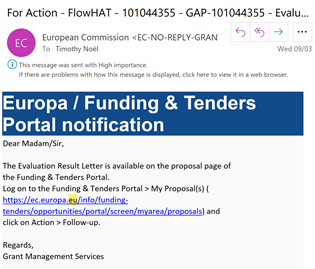
The final answer came on Wednesday March 9. As Figure 1 shows, nothing can be found in the email itself. You had to login on the portal. And I dared not click on the link… When I did, I had to fill in my password, which of course, I did not remember. So I had to request another one. Time was ticking and my heart was going like crazy.

Figure 1. Email received from the European Commission.

Finally, I got in. And I started reading (Figure 2), I got an A and the proposal was ranked for funding. But I really didn’t like the “if sufficient funds are available” line. What did it mean? Is it now funded or not? The panel comment seemed to be going in the direction of funded: “The panel therefore recommends the proposal to be retained for funding with a grant not exceeding 2,000,000 Euro.” But I was still not sure, so I opened the president letter (Figure 3): it starts with a lot of generic information but then I read “I am pleased to inform you that your proposal was ranked at a sufficiently high position to allow it to be funded.”  I was now sure that it was granted and I let out a scream of pure joy!

Figure 2. Screenshot from the Evaluation Letter
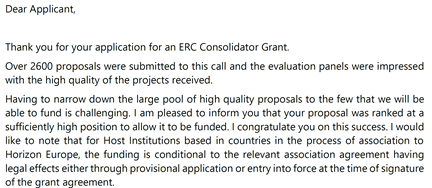
Figure 3. The so-called president letter with the clear message: Proposal funded.
 

Conclusion

We are now one week after the fantastic news and I still cannot believe it. After 7 submissions, 4 interviews and 6 heartbreaks, I had finally got an ERC proposal funded. It is a story of six downs and one final, glorious up. I am grateful to the many people who helped me in the past years, including my research group members, my colleagues and all those who were prepared to give advice.

I hope that this story might be useful to you too in obtaining a grant, whether it is ERC or something else. My main advice is: never give up and keep trying, you always have a chance to get it. And even if you do not get it first time, or the second, or the xth time… you always learn from the experience and sooner or later you will nail it. Trust me, you will get it!

Good luck!


Timothy Noel, March 17, 2022


References
(1) Cambié, D.; Zhao, F.; Hessel, V.; Debije, M. G.; Noël, T. A leaf-inspired luminescent solar concentrator for energy-efficient continuous-flow photochemistry. Angewandte Chemie International Edition 2017, 56 (4), 1050-1054 DOI: 10.1002/anie.201611101
(2) Cambie, D.; Dobbelaar, J.; Riente Paiva, P.; Vanderspikken, J.; Shen, C.; Seeberger, P.; Gilmore, K.; Debije, M. and Noël, T. Energy-Efficient Solar Photochemistry with Luminescent Solar Concentrator-Based Photomicroreactors. Angewandte Chemie International Edition 2019, 58 (40), 14374-14378 DOI: 10.1002/anie.201908553
(3) Masson, T. M.; Zondag, S. D. A.: Kuijpers, K. P. L.; Cambié, D.; G. Debije, M. and Noël, T. Development of an off-grid solar-powered autonomous chemical mini-plant for producing fine chemicals. ChemSusChem 2021, 14 (24), 5417-5423 DOI: 10.1002/cssc.202102011
(4) Bottecchia, C.; Rubens, M.; Gunnoo, S.; Hessel, V.; Madder, A.; Noël, T. Visible Light-Mediated Selective Arylation of Cysteine in Batch and Flow. Angewandte Chemie International Edition 2017, 56 (41), 12701-12707, DOI: 10.1002/anie.201706700
(5) Bottecchia, C.; Erdmann, N.; Tijssen, P. M. A.; Milroy, L-G.; Brunsveld, L.; Hessel, V.; Noël, T. Batch and flow synthesis of disulfides by visible light induced TiO2­ photocatalysis. ChemSusChem 2016, 9 (14), 1781-1785 DOI: 10.1002/cssc.201600602
(6) Bottecchia, C.; Wei, X-J.; Kuijpers, K. P. L.; Hessel, V.; Noël, T. Visible light-induced trifluoromethylation and perfluoroalkylation of cysteine residues in batch and continuous flow. Journal of Organic Chemistry 2016, 81 (16), 7301-7307 DOI: 10.1021/acs.joc.6b01031
(7) Laudadio, G.; Deng, Y.; van der Wal, K.; Ravelli, D.; Nuño, M.; Fagnoni, M.; Guthrie, D.; Sun, Y. and Noël, T. C(sp3)–H Functionalizations of Light Hydrocarbons Using Decatungstate Photocatalysis in Flow. Science 2020, 369 (6499), 92-96 DOI: 10.1126/science.abb4688

Leaving Eindhoven University of Technology, Joining University of Amsterdam

I have some very exciting news to share with you: The Noel Research Group will move up North and join the Van ‘t Hoff Institute for Molecular Sciences (HIMS) at the University of Amsterdam, where I will be promoted to Full Professor and be the chair of Flow Chemistry. The move is planned for September 1st of this year, so quite rapidly.

What can you expect from us at UvA? Our mission has always been to extend the available chemical space by embracing technology to the fullest extent. For sure, we will keep doing that using our key technology, flow chemistry! But we would not move if there were no exciting new opportunities. HIMS has a strong hub of homogeneous catalysis with a.o. the groups of Profs. Joost Reek, Bas de Bruin, Tati Fernández-Ibáñez and Francesco Mutti. We foresee some strong interactions with their teams in the years to come. So keep an eye on our website and social media channels.

Via this way, I also would like to thank the colleagues at Eindhoven University of Technology. They gave me the chance to kick start my academic career and supported me all the way, even now with the transfer to Amsterdam. Needless to say that I will miss the colleagues and the great atmosphere in the Chemical Engineering and Chemistry department.

Finally, thank you to everyone for the support and faith that has brought us to this moment.

Tim

July 30, 2020

Amsterdam, The Netherlands

Turning on the Light Alkanes: from Fuel to Valuable Reagents

Hot off the press! Our latest work on photochemical activation of light alkanes just appeared in Science (https://doi.org/10.1126/science.abb4688). We are stoked to present our group’s first Science paper to the community. In this blog article, we would like to discuss the human story behind this amazing project.

New project, new challenge

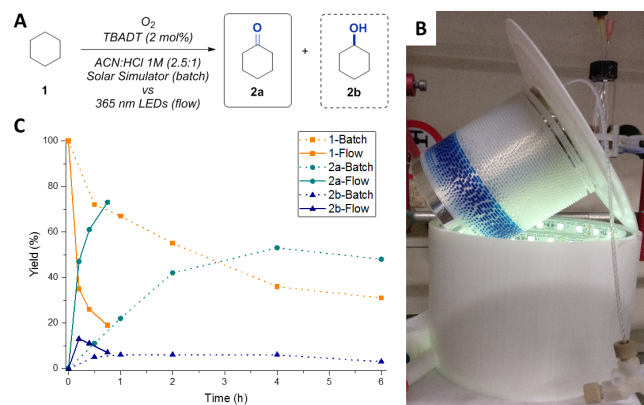
After our first project on the C(sp3)–H oxidation using decatungstate-photocatalysis, published almost two years ago in Angewandte Chemie (https://doi.org/10.1002/anie.201800818), we were looking for a new challenge where we could exploit the potential of this potent hydrogen atom transfer (HAT) catalyst. The NRG-TBADTeam (nickname of the subgroup dedicated to TBADT chemistry) focused its attention to a valuable -yet absent in organic synthesis- class of gasses which could benefit from continuous-flow microreactor technology: the volatile alkanes, such as methane, ethane, propane and butane. These compounds are mostly burned to release its energy for heating applications or propulsion, while in the chemical industry they are used as inexpensive starting materials for the synthesis of haloalkanes or polymer monomers (e.g. ethylene). Hence, we wondered if we could activate these inert and insoluble gasses with TBADT and immediately engage them in synthetically-useful transformations of interest to the organic chemistry community. Such a strategy would allow us to bypass the current toxic halogenation industry.

We commenced our investigations with propane and borrowed a bottle of high purity propane from our TU/e colleague Prof. F. Gallucci. To our delight, we could immediately spot some interesting reactivity. We were particularly delighted by the excellent selectivity provided by decatungstate for the most substituted carbon of propane (86:14 ratio for the instalment of a secondary propyl versus primary propyl moiety). At that point, master student Klaas van der Wal joined the group and together with him the real optimization commenced. Klaas did an amazing job, especially in the design of the flow setup, which was crucial to bring the gaseous reactants into contact with the soluble catalyst and substrates, and the initial reactivity screening. He received a great score for his MSc defense (Figure 1). However, we were not done yet!

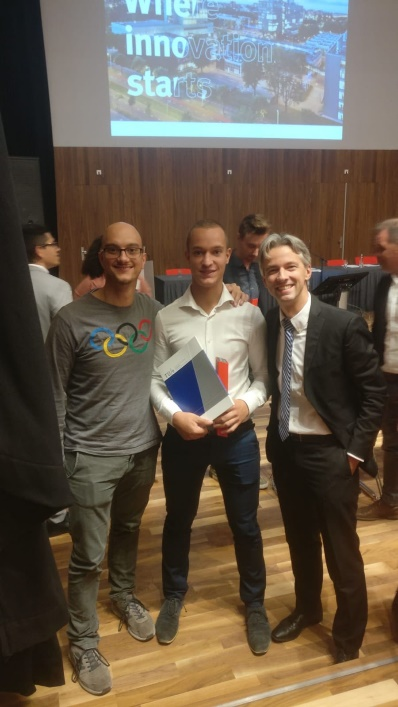
Figure 1. TU/e M.Sc. student Klaas in action: left) at the Master thesis presentation and defence; right) graduation ceremony.

Shine brighter

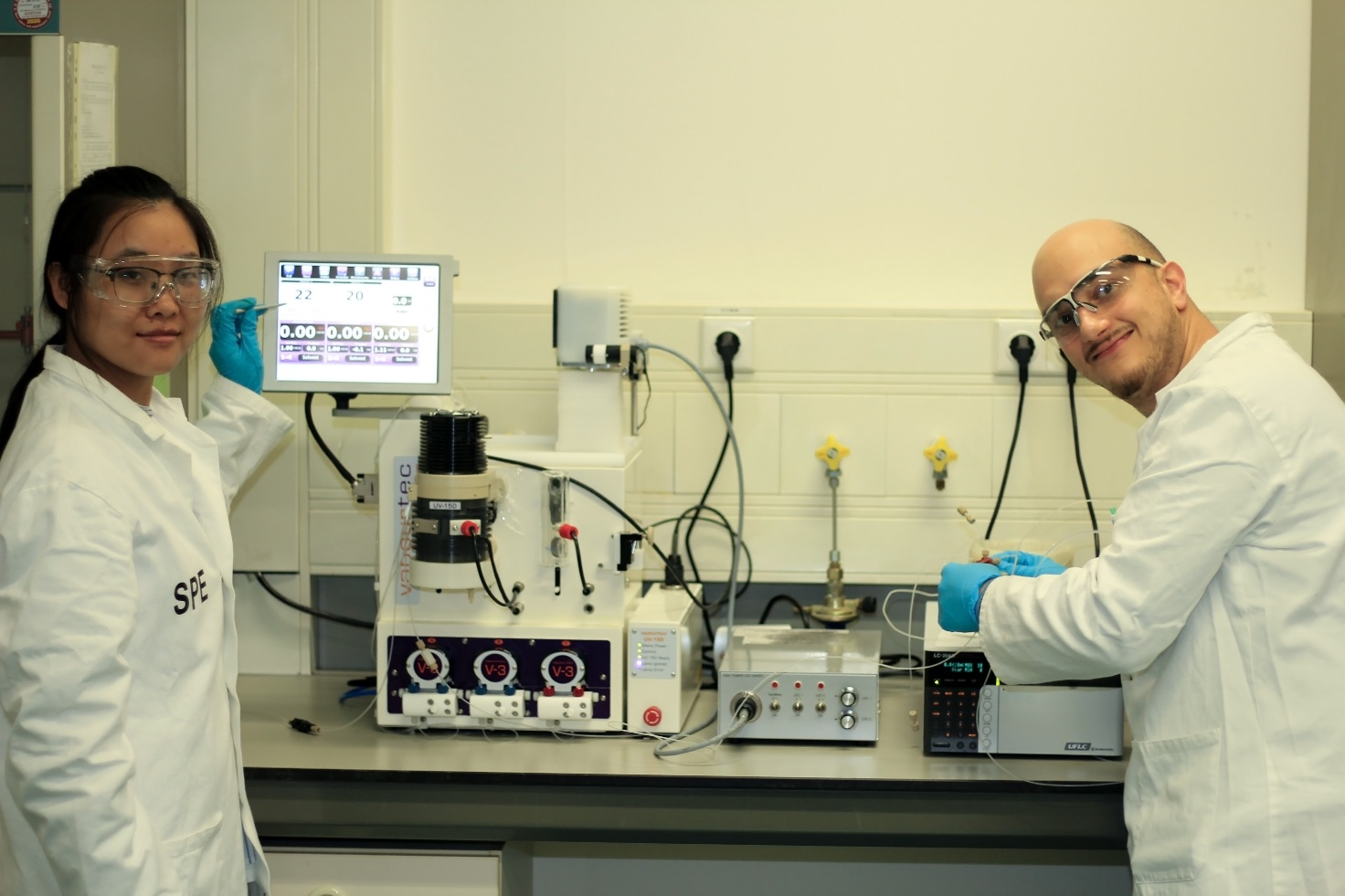
Even if an extensive optimization was already conducted at that point, we managed to run our reactions only in stop-flow mode to reach full conversion. We realized that a more powerful light source was needed to reduce the reaction time. More photons were going to be crucial in order to move to a continuous operation of the flow reactor. For this reason, we decided to employ a Vapourtec setup, which was provided to us by Vapourtec’s CEO Duncan Guthrie and Dr. Manuel Nuño. Thanks to this photochemical flow system equipped with a powerful 365 nm LED set (60 W or 150 W, the latter high power 365 nm light source was even a prototype which proved crucial in our reaction discovery), we could easily move to a continuous-flow mode and complete our last screening.

At that point, Tim asked Yuchao Deng, who was a visiting Chinese PhD student in our lab, to join the TBADTeam. With her hard work and dedication, we were able to rapidly carry out the propane optimization and to identify the substrate scope. During the scope exploration, the input from Profs. Maurizio Fagnoni and Davide Ravelli was of great value to make rapid progress. They have been working with this catalyst for many years and TBADT has essentially no secrets for them anymore.

Next, we evaluated a variety of different alkane gases, starting with isobutane. Activation of isobutane led to a new methodology which allowed to introduce tert-butyl groups in a straightforward and selective fashion (96:4, tert butyl versus isobutyl).

Figure 2. Gabriele and Yuchao working with the Vapourtec setup.

Methane? Yes, we can!

We must acknowledge that at point we were quite satisfied with the results but we were still anxious as two formidable challenges laid ahead of us: the activation of ethane and methane. These alkanes possess the strongest C(sp3)–H bonds known in Nature and we were not sure whether decatungstate would be able to cleave those selectively… Methane for example has been a daunting challenge for many decades, occupying many researchers without much success so far. Cleaving methane’s C(sp3)–H bonds requires extremely high temperatures (> 500 C) and is only industrially done for a few processes.

For ethane, we needed to crank up the pressure a bit to get it into a liquid state. However, overall the activation went pretty smooth and only minor optimization was required to obtain a satisfactory scope.

Finally, we were ready to take on the challenge of methane. If this one would work, we knew it would be a big deal. And … we had probably a good shot to get it into a true top journal. In our first attempts, we could spot the right product only in traces. We realized that the major products obtained were propylated adducts or compounds derived from the activation of acetonitrile. The presence of propylated compounds puzzled us for a while. However, we realized that the gas line might still contain some propane from our previous experiments. Indeed, by applying vacuum on the gas lines, we could remove traces of condensed propane fairly quickly. With propylation being resolved, we saw that the HAT on acetonitrile was still prominent, and only a low yield was observed for the desired methylated product. We then realized that activation of acetonitrile was favoured over the activation of methane. Even if this result could be expected based on BDE, we originally thought that the polarity mismatch of the C-H bonds of acetonitrile would prevent this side reaction. This was indeed the case for butane, propane and ethane but not for the strongest C–H bonds present in methane. To circumvent this, we employed d3-acetonitrile. Once we did that, we finally obtained the desired products in synthetically useful yields. After isolating our first methylated molecule, Yuchao and I were so happy that I cannot even describe it in words. We repeated at least a thousand times “WE DID IT!” jumping all over the lab. Definitely, that was not a quiet day for our labmates.

Hard times, high hopes

When we were wrapping up our experiments, the pandemic crisis was advancing very fast. As an Italian, I was extremely aware of the potential threat of COVID-19. Yuchao was even more scared than I was, especially because her time in the NRG group was almost over and she would not be able to go back to China as her flights got systematically cancelled. Despite the COVID stress, we completed all the necessary experiments. Tim wrote the paper and submitted it to Science on February 26, a couple of weeks before the inevitable lockdown of our group (March 13, 2020). Then we waited, isolated at home.

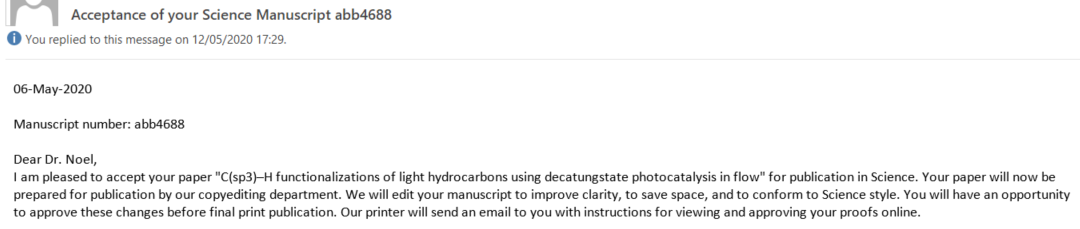
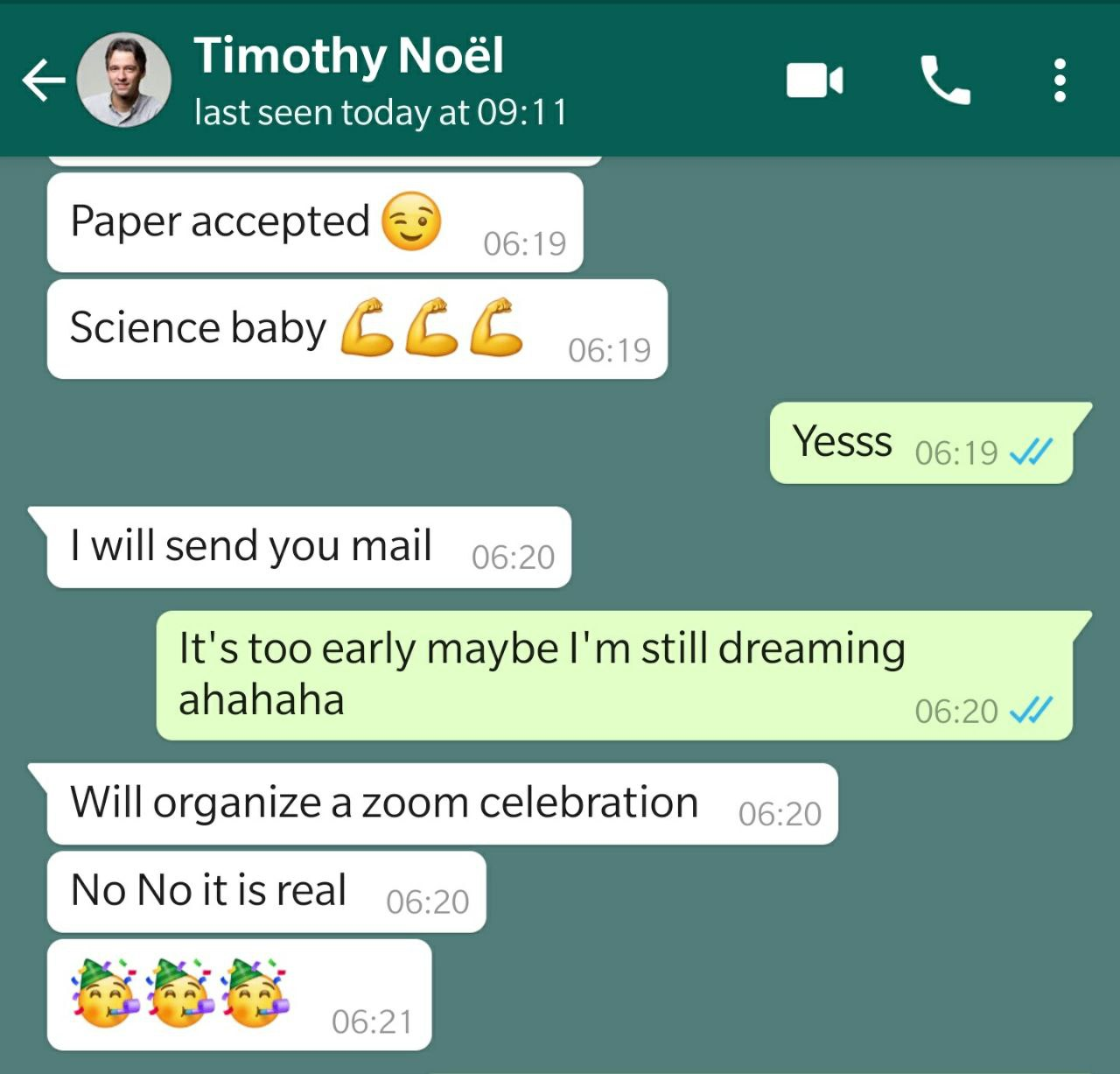
On April 7, we got news! We received a request to submit a revision, so not rejected. What a relief! After reading the feedback from the referees, we were cautiously optimistic. Yet we were also scared! We felt we could smell our first paper in Science and we did not want to mess it up. After some Zoom calls with all co-authors, we submitted a carefully revised version and waited again, all of us still sheltered in place. On May 6, 2020, we finally got the acceptance letter (Figure 3, Top). As the email came in quite late in Europe, Tim was already sleeping. On May 7 at 6.20 AM, he send me via WhatsApp some very exciting messages (Figure 3, Bottom).

Figure 3. Top: Email with the long awaited final decision. Our first paper in Science is a fact. Bottom: WhatsApp conversation between Tim and myself (Gabriele Laudadio).

We are now July 2nd, almost two months later. The paper just got published in the latest issue of Science. But I still need to pinch myself regularly to know I am not dreaming. I will cherish these memories forever.

Ciao,

Gabriele


The paper discussed in this blog was published as “C(sp3)–H functionalizations of light hydrocarbons using decatungstate photocatalysis in flow”. by Gabriele Laudadio, Yuchao Deng, Klaas van der Wal, Davide Ravelli, Manuel Nuño, Maurizio Fagnoni, Duncan Guthrie, Yuhan Sun, and Timothy Noël, Science 2020, DOI: 10.1126/science.abb4688.

Tim Presented a Commemoration of Prof. Jun-ichi Yoshida’s Work at the Flow Chemistry Europe 2020 in Cambridge

During the Flow Chemistry Europe 2020 (Cambridge), Tim has used his speaker slot to commemorate our colleague and friend Prof. Jun-ichi Yoshida, who passed away on Saturday, September 14, 2019.  He was one of our regional editors at Journal of Flow Chemistry. He also served as the president of the National Institute of Technology Suzuka College and was emeritus professor of Kyoto University. Most of all we will remember Prof. Yoshida for his excellent work in Flow Chemistry. He coined the term “Flash Chemistry” for ultrafast reactions which can be done selectively in microreactors by taking advantage of the fast mixing and the excellent heat control. He also pioneered the so-called “cation pool” method, which allowed to accumulate anodically radical cations at low temperature. These could be subsequently converted in the presence of nucleophiles in a very controlled and reliable fashion.

Generally, one cannot overstate the achievements of Prof. Yoshida in Flow Chemistry. He can rightfully be called one of the pioneers and legends of the field. Many of us, including myself, have found inspiration in his early work and have tried to follow his lead at the outset of our career.

On a personnel level, I always enjoyed talking to Jun-ichi. He was very supportive to young flow chemists. He was very social and loved drinking a good glass of wine or sake.

Prof. Yoshida’s death is a great loss for the scientific community and we will miss him dearly.

The lecture can be downloaded as pdf using the following link: Talk_YoshidaMemorial

Timothy Noël

Flow Chemistry Europe 2020, Cambridge (UK); March 3, 2020

Making Sulfonamides via Electrochemistry by Activating Commodity Chemicals

Our most recent paper dealing with the electrochemical synthesis of sulfonamides was just published in Journal of American Chemical Society (DOI: 10.1021/jacs.9b02266). For our group, it was the first paper in this prestigious journal and we are particularly proud of the work itself. It has been an interesting project which required a lot of hard work by many co-authors and we are happy to take you today behind the scenes and providing you with some insights in the discovery process.

Figure 1. Graphical abstract of our “Sulfonamide synthesis through electrochemical oxidative coupling of amines and thiols”.

In search of inspiration

Our group is mostly known for its work on flow photochemistry but about three years ago, we started getting interested in electrochemistry. For us, electrochemistry seemed like a complementary activation mode compared to photoredox catalysis, both allowing to generate synthetically useful radicals. In addition, electrochemical setups are often affected by process-related problems, like mass- and heat-transfer limitations, which was for us the proof that a technological solution would of great added value.

After our first paper on the electrochemical oxidation of thioethers and thiols,1 we decided to design a new electrochemical flow microreactor to carry out our chemistry in a more reliable and scalable way.2 In the meantime, we started thinking about new electrochemical transformations that we could develop. The group’s aim is to develop new, useful synthetic methodology and utilize cutting-edge technology to give a further boost to the chemistry. At that time, our experience on electrochemistry was still very rudimentary and we were reading a lot of different publications to get a bit an image of the field. Ultimately, we found an amazing review entitled “Nonaromatic Aminium Radicals”.3 After reading this review carefully, we had an idea: what if we try to make sulfenamides electrochemically and then further oxidize these species to make sulfonamides? We had already some expertise with the oxidation of thioethers and if we could combine both the S–N coupling with the subsequent oxidation of the sulfur, we had a great method that allowed us to activate commodity chemicals, such as thiols and amines. Moreover, sulfonamides are interesting moieties which are quite common in pharmaceuticals and agrochemicals. Recently, a couple of interesting methods to prepare or functionalize sulfonamides appeared in the literature, incl. the work of Willis4 and MacMillan.5 Taken all of this information together, we had the feeling that this project would be both challenging and of high interest to the synthetic community.

Figure 2. Original idea for the synthesis of sulfonamides.

A working reaction = A wedding present for Gabriele

At that time, Lisa Struik joined our group for her master thesis. Initially, she worked on the experimental validation of our electrochemical flow reactor.2 When that project was finalized, we suggested her to try this idea we had on the synthesis of sulfonamides. Eager to work on this new project, she started with the experiments. One of the first things she said was the following: “We have a huge problem: the reaction is forming a solid and crashes out in pure acetonitrile. I can NOT carry this out in flow!” Our answer to this was “It is probably just the acid-base adduct, just add a bit of water and it will be fine”. Indeed that solved the issue pretty well and not only that, it really boosted the reactivity significantly. To our delight, the results were almost immediately perfect. You cannot imagine how excited we were when we saw that the major product was not the sulfenamide, but the sulfonamide directly!!! This gave us the confidence to increase our research efforts: We started right away with the further optimization and got some help from Christiane Schotten. Christiane was a visiting PhD student coming from the Browne group at Cardiff University and she helped us to test different reaction conditions, residence times, mediators and acids.

Once we had the optimal reaction conditions in hand, Christiane and Lisa started working on the substrate scope. Gabriele had to take a short break at that point as he got married and went on honeymoon on a cruise. Gabriele still remembers that every time they went on land he was anxious to check his emails to know if there was any progress. Upon his return, we had to say goodbye to Christiane and Lisa and for a while, Gabriele had to work alone on the scope. Luckily, Efstathios Barmpoutsis (AKA Stathis), another master student, joined the project, rolled up his sleeves and got immediately to work. It was at that point that we realized how crucial it was to clean the electrodes thoroughly in between reactions. If you don’t do that, yields drop gradually and the results are difficult to reproduce. However, with the proper cleaning, as we described in detail in the Supporting Information of our manuscript, this issue is completely overcome and highly reproducible results are obtained. A little bit later another issue arose: heterocyclic arenes were completely unreactive under our reaction conditions (Figure 3). After some optimization of the reaction conditions, we found that the reaction could be carried out when 1 equiv. of pyridine was added to the reaction mixture. We surmise that pyridine functions mainly as an electron mediator. To be sure, we also evaluated whether its presence was required in the other reactions we already screened but there it did not prove to be essential.

Figure 3. Optimization of heteroaromatic compounds

While Stathis and Gabriele were working on the reaction scope, an Erasmus student Sebastian Govaerts joined the team. (Basically, he returned to our group as he previously worked with Gabriele on the sp3 C–H oxidation project.6) He focused mainly on the batch scope as we wanted a thorough comparison with the results obtained in flow. In most cases, the yields were lower in batch and the reaction required 24 h and 100 mol% of supporting electrolyte to reach full conversion. In flow, the reaction was done within 5 min and needed only 10 mol% of supporting electrolyte. However, batch does have its advantages. For those reactions that were very slow or resulted in precipitate formation, we preferred the batch procedure.


Figure 4. (Left) Electrochemical batch reactor; (Right) Electrochemical flow reactor

With the finish line in sight – What is the mechanism?

Within sight of the finish line, it was time to gain some mechanistic understanding. Kinetic experiments revealed that the thiol dimerizes within 20 seconds to the corresponding disulfide. This observation indicates that some of the most odorous thiols can be replaced by their corresponding disulfide, a feature most chemists will be happy about. Next, Gabriele started with some quenching experiments and he was able to rapidly trap the aminium radical. With that preliminary result in hand, we were almost sure that the sulfenamide was one of the intermediates in our transformation. Indeed, we were able to isolate some sulfenamide and when subjected to our reaction conditions, the targeted sulfonamide was obtained in quantitative yield.

Finally, we had to do some cyclic voltammetry. Using a potentiostat, Gabriele recorded spectra of all relevant starting materials, including amines, thiols and disulfides. Despite some hints, it proved to be not enough evidence to pinpoint the entire mechanism. Then he decided to “titrate” thiophenol with cyclohexylamine and recorded different spectra. We firmly believe in the famous Latin maxim “Fortuna audaces iuvat”, which means literally “fortune favours the bold”. Indeed, at a certain moment, we found some white precipitate in the cell. It was a Friday evening, around 8 pm. Gabriele filtered the precipitate and ran to the NMR: indeed, it was the cyclohexylammonium thiophenolate (Figure 5), as was also observed by Lisa. And, when we tried to record the cyclic voltammogram of that compound, we knew that we had finally found the missing piece (Figure 6). We still carried out some additional control experiments to be 100% sure (you can find them in the supporting information of the paper) but from that moment on we knew the work in the lab was basically done.

Figure 5. Picture of the white solid and its 1H NMR spectrum

Figure 6. CV of cyclohexylammonium thiophenolate

A final word

The possibility to obtain complex moieties, such as sulfonamides, simply by stitching two commodity chemicals together using electrons is, in our opinion, a key feature of our electrochemical methodology. Moreover, we saw that microflow technology really made a difference in this transformation providing the experimentalist with practical reaction conditions and operational flexibility to rapidly investigate the reaction scope. This can be attributed to the small interelectrode gap (250 μm), the high mass transfer to the electrodes and the large electrode surface to volume ratio.

Currently, we are working hard to finish some more electrochemical methods of which we are really excited. So stay tuned and keep an eye on our group website and twitter accounts.

Ciao,

Gabriele and Tim

The paper discussed in this blog was published as “Sulfonamide synthesis through electrochemical oxidative coupling of amines and thiols”. by Gabriele Laudadio, Efstathios Barmpoutsis, Christiane Schotten, Lisa Struik, Sebastian Govaerts, Duncan L. Browne, and Timothy Noël, Journal of American Chemical Society 2019, DOI: 10.1021/jacs.9b02266

References:

[1] Laudadio, G.; Straathof, N. J. W.; Lanting, M. D.; Knoops, B.; Hessel, V.; Noël, T. Green Chem. 2017, 19 (17), 4061–4066.

[2] Laudadio, G.; de Smet, W.; Struik, L.; Cao, Y.; Noël, T. J. Flow Chem. 2018, 8 (3–4), 157–165.

[3] Chow, Y. L.; Danen, W. C.; Nelsen, S. F.; Rosenblatt, D. H. Chem. Rev. 1978, 78 (3), 243–274.

[4] Chen, Y.; Murray, P. R. D.; Davies, A. T.; Willis, M. C. J. Am. Chem. Soc. 2018, 140, 8781-8787.

[5] Kim, T.; McCarver, S. J.; Lee, C.; MacMillan, D. W. C. Angew. Chem. Int. Ed. 2018, 57, 3488-3492.

[6] Laudadio, G.; Govaerts, S.; Wang, Y.; Ravelli, D.; Koolman, H. F.; Fagnoni, M.; Djuric, S. W.; Noël, T. Angew. Chem. Int. Ed. 2018, 57, 4078-4082.

A Great Tool for Fluorescence Quenching Studies and Stern-Volmer Analysis – the Story Behind our Automated Continuous-flow Platform

Frustration as a source of inspiration

I am pretty sure any PI can name a few experiments which their students detest. Not because they are useless (despite the often-used bluff feedback that it is “not absolutely necessary” for the paper), but because these experiments are tedious, time-consuming and frustrating. Amongst the most hated experiments, one could easily place measuring IR spectra (Such an old technique, who needs that anyway?), distilling reagents and solvents (Can’t we just buy a new bottle?), titrations (Do you not believe the concentration written on the bottle?), … In our lab, and probably in many other ones, a special place on that ranking is occupied by Stern-Volmer analysis.

Those of you working on photoredox catalysis probably know too well what I am talking about. For those who don’t, here’s a brief explanation: once in their excited state, photocatalysts tend to return to their ground state by dissipating the energy in the form of emitted light (also called fluorescence). However, in the presence of appropriate organic molecules (often referred to as quenchers), the excited photocatalyst can transfer that excited state energy to a suitable quencher via a single electron or energy transfer. As a result of this interaction, a reduction in the fluorescence of the photocatalyst can be observed (Figure 1). The kinetics of this phenomenon can be explained by the Stern-Volmer relationship, thus making this experiment crucial to elucidate which molecule(s) can interact with the photocatalyst and at which rate they can do so. In other words, the Stern-Volmer relationship provides valuable information in the elucidation of any photocatalytic reaction mechanism.

However, as for all kinetic studies, Stern-Volmer kinetics is not that easy (Figure 1). The process is labor-intensive and sensitive to oxygen, thus often making it difficult to obtain quantitative data. In our own experience, we noticed that, depending on the students’ experience (BSc, MSc, Ph.D. or postdoc level), we usually obtained good qualitative results but the reproducibility and accuracy of the data were often problematic. Since we strive to publish the best achievable data, this eventually resulted in the necessity to repeat the experiment several times, sometimes even by several different students. Talking with other colleagues in the field, we realized this was somewhat a general issue in many groups. In some labs, they even attempted to fix this problem by appointing one student as the Stern-Volmer expert, in order to avoid wasting too much time.

As frustration is typically a good reason to initiate change, we felt that an automated tool to conduct Stern-Vomer analysis would be extremely useful (Figure 1). It would not only greatly reduce valuable experimental time but it would also make sure that the process can be carried out with high precision and reproducibility by basically any chemist, regardless of their experience. Automated platforms have become increasingly important and have often been combined with flow chemistry to assist chemists in their synthetic efforts. Seminal works by the groups of Jensen (MIT), Bourne (Leeds), Ley (Cambridge), Rueping (RWTH) and many others have paved the path for a future in which a machine-assisted approach towards organic synthesis allows chemists to disregard the routine aspects of their laboratory work.[1] Indeed, we felt that Stern-Volmer and other quenching studies were requiring too much of our precious research time.

Figure 1. Stern Volmer kinetics: the equation (top), fluorescence quenching by adding increasing amounts of quencher (bottom left), comparison batch and automated flow procedure (bottom right).

The kick-off of our automation activities

At that point, we had little to no experience with the automation of chemical processes. However, at TU Eindhoven, we are lucky to have every year bright Chemical Engineering MSc students, who are motivated to take on important challenges within their graduation thesis. Under Koen Kuijpers and Dario Cambie’s supervision, Koen Drummen (having too many Koens at the same time in the lab was also confusing for us, so we started calling them Koen2 for brevity J) started his thesis in September 2016 working on the project. He took our UV-VIS spectrophotometer (Avaspec-2048) and equipped it with a 100 μl quartz flow cuvette which allows measuring the fluorescence of the photocatalyst (Figure 2). Inspired by the Glorius mechanism-based luminescence screening method,[2] we also envisioned to carry out automated screening experiments of various quenchers. For this reason, Koen Drummen also installed an autosampler which allowed us to inject different quenchers sequentially into the continuous-flow stream.

Figure 2. Schematic representation of the automated platform. 3D-printed customized holder for the flow cuvette (inlet right and outlet left). Close-up of the flow cuvette housed within the holder.

Installing and connecting all the different units together was relatively straightforward. The real confrontation, in this case, was to write a suitable code to make sure all the different units can talk to each other. Hereto, we had to learn Python. I still remember entering the office and seeing Koen2 watching YouTube videos to solve all their issues with the code. Who doesn’t love a nice YouTube tutorial? We partly have to thank some YouTubers: in the end, Koen2 fixed the code and started to run the first automated fluorescence quenching screenings.

Next, we also developed a graphical user interface which allows you to rapidly fill in the compounds to be screened (Figure 3). This makes the entire automated setup really intuitive, basically making it possible for anyone to perform Stern-Volmer quenching experiments, regardless of their ability to code. A cool feature of our software is that, once the analysis is finished, the results are automatically sent by email as a pdf file. Easy enough, right?

Figure 3. Screenshots of some of the graphical user interfaces of the software developed for the automated platform.

At that point (we are now early 2017), another MSc student, Niels Koenig, joined our group eager to further improve the software. He added a new feature to the software, namely the possibility to automatically color-code the results obtained in the quenching experiments. If a compound was found to be a strong quencher (> 50% quenching efficiency), a green color was assigned to its fluorescence peak while a weak quencher (< 25% efficiency) was assigned a red color. This feature gives in one blink of an eye the confirmation on which quenchers are interesting to test in further reactions and which ones can be discarded.

Time to test the automated platform.

Once our engineers had a working platform ready, it was time to put it to the test. At this point, I asked our photocatalysis expert Cecilia Bottecchia to collaborate with Koen Kuijpers to see how we could take advantage of the technology. The first thing we did was a Stern-Volmer analysis to determine the rate at which TMEDA can quench the excited state of 9-mesityl-10-methyl acridinium perchlorate (Mes-Acr+) (Figure 4). By adding in flow increasing concentrations of quencher, a progressive decrease of the fluorescence emission intensity can be observed. Next, the software converts the obtained data into the classical linear Stern-Volmer profile. From the slope of the line, one can now easily obtain the quenching kinetic constant for a certain quencher. Notably, ten consecutive experiments demonstrated that the data produced by our automated platform was consistent and reproducible, with exactly the same slope (and thus quenching kinetic constant) in each experiment! What a difference compared to our laborious manual procedure!

With the optimized system, we could now run a single Stern-Volmer experiment within only 15 minutes. The only thing you need to do is to prepare the photocatalyst and the quencher solutions. After that, it’s all about hitting the start button, sit back, relax (or work on something else :)) and enjoy your results.

Figure 4. Quenching of Mes-Acr with increasing amounts of TMEDA: (A) Raw data obtained by the automated platform; (B) Stern-Volmer plot automatically generated by the software. Note the tiny error bars, which reflects the data of 10 consecutive experiments.

Next, we investigated several case studies to validate the screening option of our platform. One specific example that we carried out was the mechanistic investigation of the Ir(ppy)3-catalyzed photocatalytic decarboxylation of cinnamic acids developed by Xiao-Jing Wei in our group.[3] Cecilia prepared the stock solutions and found rapidly that the software and hardware could rapidly generate the data which was required to elucidate the mechanism (Figure 5). It should be noted that in all cases, we obtained high-quality data with R2 >0.99. Now, in one single hour, we obtained both qualitative and quantitative data, while previously we had to struggle sometimes days to get the quantitative data. It might still be true that, as one referee pointed out, “a good photochemist can run a Stern-Volmer analysis in 30 minutes” but we still believe that you will have to work really hard to get everything done in this timeframe. We did some other screening procedures with our system as well but we invite you to have a look at our paper for all the experiments we did. The bottom-line is that such experiments have become a piece of cake making it actually fun to do.

Figure 5. Results obtained with our automated platform for the mechanistic investigation of the photocatalytic decarboxylation of cinnamic acids to access difluoromethylated styrenes.

Outlook

Automating luminescence quenching studies has been one of those projects that really changed the daily life in our group. Before we had access to this platform, students hated me when I asked them to do this experiment. One even said (not a joke): “I’d rather add ten more substrates to the scope instead of doing the Stern-Volmer studies!”. While I could not be bribed (I asked for both the substrates and the SV analysis :)), I still felt that it was crucial to at least alleviate the unnecessary issues that these experiments bring along. We also like the story behind this project because it clearly shows how certain ideas take shape within our group: we wanted to develop some novel synthetic methods via visible light photoredox catalysis, but we ended up with a creative solution to overcome technical hurdles along the way. Simply put, we found a mean to our end. One anonymous referee during the peer-review process really made us proud:  “This article presents a valuable and practical advancement for the field of photoredox catalysis. […] Overall, the development of an automated flow platform that significantly accelerates the collection and processing of fluorescence quenching data in a time and labor-efficient manner will be immediately impactful to the organic community.” Our system was and still is impactful in our group and we all hope it will be for your work as well! Don’t hesitate to contact us if you want to give it a shot!

Figure 6. The two first-authors of the paper: Koen Kuijpers and Cecilia Bottecchia or also Chemical Engineering meets Chemistry. A diverse duo to solve this interdisciplinary challenge.

See you,

Tim, Cecilia and Koen

The paper discussed in this blog was published as: A fully automated continuous-flow platform for fluorescence quenching studies and Stern-Volmer analysis. K. P. L. Kuijpers, C. Bottecchia, D. Cambie, K. Drummen, N. Koenig, T. Noël, Angew. Chem. Int. Ed. DOI: 10.1002/anie.201805632.

References:

[1] (a) D. E. Fitzpatrick, C. Battilocchio, S. V. Ley, Enabling Technologies for the Future of Chemical Synthesis. ACS Cent. Sci. 2016, 2, 131-138. (b) B. J. Reizman, K. F. Jensen, Feedback in Flow for Accelerated Reaction Development. Acc. Chem. Res. 2016, 49, 1786-1796.

[2] M. N. Hopkinson, A. Gomez-Suarez, M. Tederes B. Sahoo, F. Glorius, Accelerated Discovery in Photocatalysis using a Mechanism‐Based Screening Method. Angew. Chem. Int. Ed. 2016, 55, 4361-4366.

[3] X.-J. Wei, W. Boon, V. Hessel, T. Noel, Photocatalytic Decarboxylation of α,β-Unsaturated Carboxylic Acids: Facile access to Stereoselective Difluoromethylated Styrenes in Batch and Flow. ACS Catalysis 2017, 7, 7136–7140.

How to Have Complete Control over Your Solar Photochemistry During Cloudy Days – Insight in our Real-time Reaction Control System

Our latest paper on a real-time reaction control system for the solar production of chemicals under fluctuating irradiance was published online today in Green Chemistry (DOI: 10.1039/c8gc00613j). Our solar-photochemistry research has always been characterized by the desire to reduce the gap between the lab and the rooftop, in other words we want to enable the use of sunlight as a free light source for many photochemical reactions in a simple and efficient way. With the Luminescent Solar Concentrator PhotoMicroreactor (LSC-PM) design we introduced a novel way to convert the polychromatic solar spectrum into a narrow band, while now we addressed the issue of light intensity fluctuations (e.g. due to passing clouds).1 Here, we will give you some inside information on our solution for this important issue within solar photochemistry.

Figure 1 Graphical Abstract of our “Real-time reaction control for the solar production of chemicals under fluctuating irradiance”

The problem with sunlight variable intensity
To the chemist inclined to perform photochemical reactions with solar light, one of the main limitations is represented by the uncontrollable fluctuations in solar irradiance. In particular, while the daily and seasonal variation can be predicted, short fluctuations introduced by passing clouds are the most difficult to address. In the past, we experienced this first-hand when we tested outdoors our reactions (e.g. see Figure2).

Figure 2 Impact of sky conditions on solar reaction performance.

The idea

To use the words of an anonymous reviewer, “It is common knowledge that the kinetics of photoreactions are often governed by the supplied photon flux.” Using a light sensor for adjusting the irradiation time to compensate the different irradiance might, therefore, seem trivial. Alas, reality is unfortunately far from that!

For example, the spectral distribution of solar light can change significantly throughout the day. Other than the obvious red color of sunlight at sunset and sunrise, also cloud coverage, atmospheric humidity, ground albedo and other parameters can affect the wavelength distribution of solar radiation at the ground. The only reason why we could keep our system simple is that we used a Luminescent Solar Concentrator PhotoMicroreactor (LSC-PM). In an LSC-PM, the incoming solar radiation is absorbed by a fluorescent dye that re-emits the absorbed photons in a polymeric lightguide as a down converted and narrowband beam corresponding to the dye fluorescence spectrum (see Figure 3). As a consequence of the adoption of the LSC-PM design, we could neglect the variation in sunlight spectral distribution! Furthermore, by placing a light sensor in direct contact with the device edge, the light intensity measured is proportional to the photon-flux experienced by the reaction mixture flowing in the reactor channels.2

Figure 3 LSC-PM working principle. The solar photons reaching the device are either reflected (1), transmitted (2)  or absorbed within the device. Most of the photons are absorbed by the dispersed dye molecules (red dot) that re-emit fluorescent photons that are waveguided to the reaction channels (5a) or to the device edge (4).Eventually, our reaction control system is simple and elegant. As in the quote often attributed to Leonardo da Vinci, we could say that simplicity, in this case, “is the ultimate sophistication”. 🙂

Merging chemistry and electronics

Being aware of the relationship between the light intensity emitted at the device edge and the photon flux in the reaction channel, we had to find a way to measure the former as an estimation for the latter. Thanks to the advancements in electronics, that is not a difficult task. After all, most of our smartphones have a little sensor to adjust the screen backlight to the ambient light conditions.

After a brief screening of different light sensors (photoresistors, phototransistor, integrated circuits based on PV cells) we decided to use a phototransistor thanks to its simplicity. By including it in a voltage divider circuit, the variation in the light intensity can be measured as a variation in the voltage drop across a resistor connected in series (see circuit in Figure 4).

Figure 4 Schematics of the light sensing circuit used (left) and a photo of the phototransistor fixed in a 3D printed holder to keep it on the device edge (right).

Kinetic data

With a working sensor in our hands, we needed to perform the calibration between the different light intensity levels, and the corresponding conversion at different residence time. This can be a rather laborious work but, as you might have noticed at this point, in our group we are not afraid of merging chemistry and technology. Therefore, we have developed a simple python script to control pump flow rate and LED light intensity (with a MOSFET) while measuring the reaction conversion was measured in line with a UV-VIS spectrometer. As such, this data can be obtained in fast, automated and reliable fashion.

Timing is everything

After gathering all the required data, finding the voltage/residence time relationship to keep the conversion stable was relatively easy. The first tests of the system with an artificial set of light variation were both encouraging and alarming. While the system was actually capable of adjusting the residence time to match the variation of light intensity, its reactiveness was too slow.

For a moment we feared that this might be an intrinsic limitation of our reactor (e.g. due to its elastic nature or modest volume). It turned out that the major source of variability was the delay between the light intensity reading and the adjustment of the pump flow rate. While the phototransistor responsiveness to light variation was almost instantaneous3, most of the delay was in the computer controlling the pump and the pump actually changing the flow rate. By reducing the loop time in the reaction control script to the pump response time, an update rate of less than a second was achieved. After this correction, a good stability in the reaction conversion was obtained even for large and fast variation to the external irradiance.

Arduino

Up to this point, we had been using a PC to interface with a voltmeter to read the voltage drop and to change the pump flow rate accordingly. The system was fine for lab development, but clearly, we could not propose to use it as such to control multiple reactors in a hypothetic solar mini-plant. The advantages of switching from a reaction analysis approach to monitor the reaction progress to a physical measurement that directly addresses the source of variability and that can predict the reaction outcome represented a significant conceptual difference.

We went back to the drawing board and decided to simplify the overall system with the adoption of an Arduino microcontroller. Once programmed with the kinetic investigation data, the controller would automatically send commands to the syringe pump to correct the flow rate based on the voltage measured in the light sensor. In this way, both the multimeter and the PC are replaced by an inexpensive integrated circuit. Tim particularly liked the inexpensive nature of this solution, whose total cost was about 50€. Actually, by using a generic Arduino instead of a genuine one or by including all the components in a single printed circuit board, the price of the system could be decreased to less than 10€ per piece (and even further in case of mass production).  We believe that this system has potential to be applied for the reaction control of every solar photoreactor tested outdoors. To describe it with the words of another anonymous reviewer: “The potential of this to thus be completely automated will bring legitimacy to the idea of actually using solar to perform synthetic organic chemistry in practice”. And that is exactly the goal we are working towards!

Figure 5 The 3D-printed box with the Arduino microcontroller that we used for the experiments. It is possible to connect up to 6 phototransistors (bottom right) and two between pumps and mass flow controller (serial connections, on top). The measured voltage and status are shown in the display on top.

Outdoor experiment

Finally, as usual in our LSC-PM papers, we tested the reaction control system outdoors on a cloudy day, luckily those cloudy days are quite common here in Eindhoven… The system worked as planned and could handle challenging weather conditions (read: frequent and steep variations due to passing clouds). Once we got these results, we went back to the office with a big smile and finalized the paper writing process.

Figure 6 On the left the setup used for the outdoor experiments, the reactor on the left is connected to the light sensor while that on the right is not. On the right, our PI Tim, checking that everything runs smoothly during our experiments on the rooftop of the Architecture Department building.

Outlook

It is undeniable that the dilute nature of solar energy will never make it suitable for the production of bulk chemicals. The volumes and margins of fine and specialty chemicals, on the other hand, constitute a real possibility for solar photochemistry. One should also realize that the use of solar energy is basically for free and abundantly available. Especially when energy prices will rise (it is just a matter of time), these technological solutions might make the difference! We believe that our paper is yet another step in our lab’s effort towards simple and more efficient solar photoreactors. Ultimately, we hope to see our technology implemented in the solar synthesis of some life-saving drugs! 🙂 🙂

Bye!

Fang, Dario, and Tim

1 To this is particularly relevant the Whitesides’ recent perspective on the future of organic chemistry: “Another possible direction for the future evolution of Organic Synthesis is, in effect, to fuse (at least in part) with Chemical Engineering, and use the techniques of that area to simplify processes […]

2 More details on this in the Monte Carlo ray-tracing simulations that we have published last year.

3 10 µs according to manufacturer specifics